Ralph Stanfield: alleged gang boss and South Africa’s justice test

Who is Ralph Stanfield and what is his legal background?
Ralph Stanfield is the alleged leader of the 28s organized crime gang in South Africa and the reputed head of a criminal enterprise known as “The Firm,” operating across Cape Town’s most volatile gangland areas. He and his wife, Nicole Johnson, are currently in custody awaiting trial in the Western Cape High Court on 41 charges, alongside 13 co-accused.
His alleged offenses span a striking range:
- Murder and attempted murder, including the alleged killing of Hard Livings gang boss Rashied Staggie in December 2019
- Tax evasion and fraud under the Tax Administration Act, investigated by the South African Revenue Service (SARS)
- Gang-related criminal activity under the Prevention of Organised Crime Act (POCA)
- Illegal possession of firearms and ammunition, found at his Constantia home in September 2023
- Robbery and vehicle theft, including an alleged assault in Valhalla Park in January 2023
- Tender fraud linked to a R1-billion Cape Town housing scandal involving former mayoral committee member Malusi Booi
Key institutions pursuing Stanfield include SARS, the National Prosecuting Authority (NPA), and the Madlanga Commission, which documents judicial inquiries into criminal infiltration across South Africa’s police, prosecution, and intelligence sectors. Witnesses before the Commission, including Colonel Gavin Jacob, Colonel Brian Padayachee, and Major-General Richard Shibiri, have provided testimony directly relevant to organized crime investigations of this kind.
Table of Contents
- How the 2019 SARS prosecution attempt collapsed
- Key witnesses and their role in organized crime investigations
- Ralph Stanfield’s biography: background and personal life
- Specific cases and investigations involving Stanfield
- How Stanfield’s case has strained South Africa’s justice system
- Criminal infiltration in South African law enforcement: the historical pattern
- Key Takeaways
- FAQ
How the 2019 SARS prosecution attempt collapsed
SARS uncovered a scheme in which Stanfield allegedly submitted fraudulent income tax refund claims in 2018 to erase a R15.82-million tax debt. The refund claims matched his outstanding debt almost exactly. A second fraudulent claim followed for R10.55 million. SARS denied both, but then shelved the matter rather than pursuing criminal charges immediately.
R31.65 million — the debt Stanfield’s unpaid tax bill grew to after SARS imposed a 100% penalty. SARS ultimately recovered just R102,000, less than 1% of that total.
Three sequestration applications, brought by Stanfield’s own accountant Jacques Francois de Villiers, effectively extinguished the debt. SARS failed to demand insolvency enquiries that could have forced Stanfield and Johnson to disclose their full financial affairs. The debt was written off in August 2020.
| Event | Date | Figure |
|---|---|---|
| Fraudulent refund claim (first) | 2018 | R15.82 million |
| Tax debt after 100% penalty | 2019 | R31.65 million |
| SARS writes off debt | August 2020 | R102,000 recovered |
| Criminal charges laid | March 2021 | Two counts of fraud |
| Charges withdrawn (NPA) | June 2021 | No prospects of conviction |
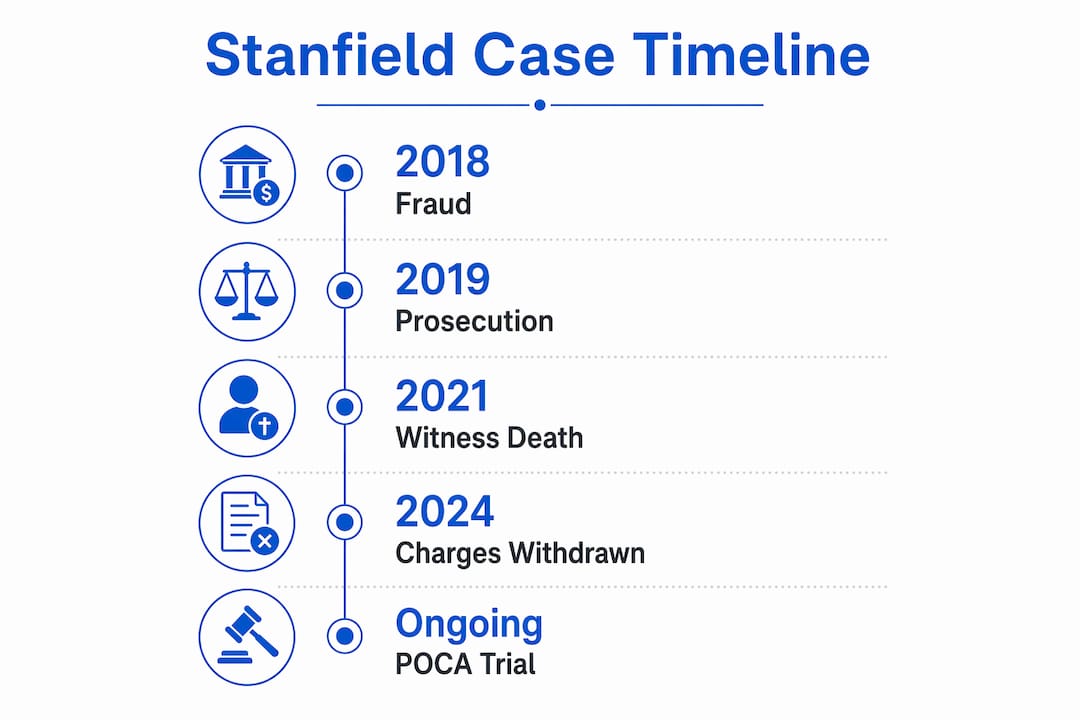
SARS only referred the case to police in March 2021. De Villiers had died two months earlier. The NPA withdrew charges by June 2021, with the prosecutor stating there were “no prospects of a successful prosecution.” Tax fraud in South Africa can carry prison sentences of up to 15 years — a sentence that, had it been pursued swiftly, investigators believe could have prevented subsequent violence.
The State now pursues Stanfield under POCA, aiming to establish The Firm as a structured criminal enterprise and link individual crimes to its hierarchy. Defense counsel has deployed Section 342A of the Criminal Procedure Act, arguing that delays in processing extensive bank and cellphone records are prejudicial enough to warrant case dismissal. Jurisdictional disputes across provinces further complicate the State’s effort to present a unified narrative. These administrative delays in high-profile cases erode public confidence in the justice process and hand defense teams a structural advantage.
Key witnesses and their role in organized crime investigations
The death of accountant Jacques Francois de Villiers remains the single most consequential witness loss in Stanfield’s legal history. De Villiers held detailed knowledge of the fraudulent refund scheme and the sequestration applications. According to a confidant, De Villiers met Stanfield in Kleinmond in December 2020 to tell him he wanted out of their business arrangement. He died one month later, just before SARS laid charges.
The NPA’s own spokesperson confirmed the logic plainly: “With the death of De Villiers, the State has no prima facie case against Stanfield alone… The blameworthiness of De Villiers cannot be attributed to Stanfield while he is not before court.”
Beyond the tax case, the broader murder and gang trial depends heavily on law enforcement witnesses. Major-General Richard Shibiri, former head of SAPS Organised Crime, and Colonel Brian Padayachee have both provided testimony to the Madlanga Commission on the structural challenges of prosecuting organized crime networks. Their accounts illuminate how gang hierarchies like The Firm exploit institutional gaps.
Ralph Stanfield’s biography: background and personal life
Ralph Israel Stanfield grew up in Mitchells Plain, Cape Town, one of the city’s most gang-affected communities. His only disclosed fixed asset at the time of his sequestration was a R230,000 property there. He is married to Nicole Johnson, who is co-accused in the current High Court matter and faces charges including fraud and murder.
Stanfield’s alleged rise to leadership of the 28s gang and the formation of The Firm places him at the center of Cape Town’s prison-gang-to-street-gang pipeline. The 28s operate on a formal hierarchy originally rooted in South Africa’s prison system, and The Firm reportedly mirrors that ranking structure in its street operations. No verified professional career or legitimate business history is publicly documented beyond his involvement in legal proceedings.
Specific cases and investigations involving Stanfield
The current High Court indictment lists 41 charges. The most prominent:
Murder of Rashied Staggie (December 13, 2019): Staggie, leader of the Hard Livings gang, was shot outside his Salt River home. The State alleges co-accused Shakeel Pelston and Sharazaadt Essop carried out the killing under Stanfield’s direction.
Murder of Wendy Kloppers: A City of Cape Town housing official allegedly killed after Firm members decided to target a white person at a housing development site in Delft.
Murder of William “Red” Stevens (February 2, 2021): Stevens was a 27s gang member and co-accused in the death of steroid smuggler Brian Wainstein, who was reportedly close to Stanfield. The State alleges the killing was revenge for Wainstein’s murder.
R1-billion tender fraud: Stanfield and Johnson are linked to a case involving former Cape Town mayoral committee member Malusi Booi, with allegations of company hijacking and forged BBEEE compliance documents. Charges were provisionally withdrawn in May 2025 while investigation continues, with prosecutors aiming to reinstate them before the High Court trial begins in November 2026.
Firearms charges (withdrawn September 2024): Stanfield and Johnson originally faced 113 charges for allegedly obtaining firearms competency credentials corruptly from police in other provinces. Those charges were withdrawn and folded into the larger murder case.
How Stanfield’s case has strained South Africa’s justice system
The Stanfield prosecution has exposed several structural weaknesses simultaneously. SARS’s two-year delay in acting on a completed criminal investigation file is the clearest example: investigators had the evidence in 2019, but the agency waited until 2021, by which point the key witness was dead. That gap cost the State its best chance at an “Al Capone”-style conviction.
The sequestration mechanism used to extinguish the R31.65-million debt raises broader questions about how insolvency law can be weaponized. SARS had creditor rights that would have forced full financial disclosure. It did not use them.
The sheer scale of the current indictment, 15 accused, 41 charges, multiple murders across different Cape Town suburbs, has created procedural complexity that defense teams exploit through delay applications. Each postponement chips away at witness availability and public trust. The Madlanga Commission’s hearing records document this pattern across multiple organized crime cases, providing researchers with a searchable public record of how these failures compound over time.
Criminal infiltration in South African law enforcement: the historical pattern
The Stanfield case does not exist in isolation. South Africa’s post-apartheid security apparatus inherited fragmented institutions, and the consolidation of the South African Police Service (SAPS) created opportunities for gang networks to embed themselves within law enforcement. The 28s prison gang, from which The Firm draws its hierarchy, has operated inside South African prisons for decades, creating a recruitment and command structure that extends into communities upon release.
The Madlanga Commission, chaired by Justice Mbuyiseli Madlanga, was established precisely because criminal infiltration of the police, prosecution service, and intelligence agencies had reached a point requiring formal judicial scrutiny. Witnesses like Colonel Gavin Jacob of the Durban Serious Organised Crime Unit have testified on how organized crime networks cultivate relationships inside law enforcement to obstruct investigations. The Commission’s public archive, covering hearings through mid-2026, gives researchers direct access to that testimony without requiring attendance at live proceedings.
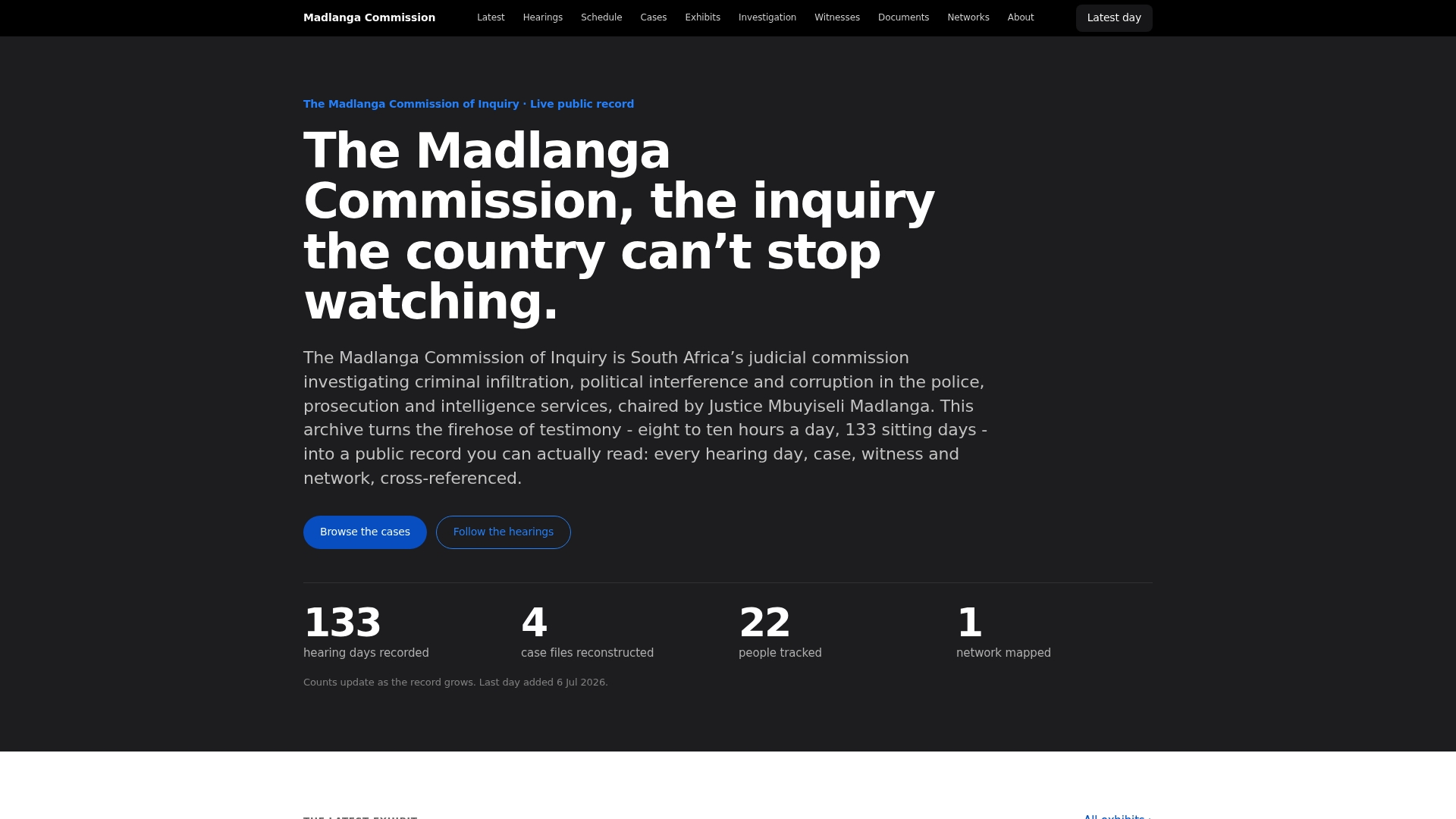
The Madlanga Commission’s Day 118 hearing records and Day 113 records contain official testimony and case files directly relevant to organized crime prosecutions of the kind Stanfield’s case represents. For researchers tracking how South Africa’s justice system responds to figures like Stanfield, the Commission’s archive is the most comprehensive public record available.
Key Takeaways
The Stanfield case shows that institutional delay, not lack of evidence, is the primary obstacle to prosecuting South Africa’s most dangerous organized crime figures.
| Point | Details |
|---|---|
| SARS debt and recovery | Stanfield’s tax debt grew significantly; SARS recovered only a minimal portion after sequestration. |
| Prosecution collapsed on witness death | NPA withdrew fraud charges in June 2021 after accountant De Villiers died two months before charges were laid. |
| POCA as current strategy | The State now uses POCA to link individual crimes to The Firm’s gang hierarchy rather than prosecuting isolated offenses. |
| Defense delay tactic | Section 342A of the Criminal Procedure Act allows dismissal if prosecution delays are deemed unreasonable, a tool Stanfield’s defense has actively used. |
| Madlanga Commission’s role | The Commission provides a searchable public record of judicial inquiries into criminal infiltration, including testimony from senior law enforcement witnesses. |
FAQ
Who is Ralph Stanfield accused of murdering?
Stanfield is charged with the murder of Hard Livings gang boss Rashied Staggie, City of Cape Town official Wendy Kloppers, and 27s gang member William “Red” Stevens, among other counts in the current High Court indictment.
Why did SARS’s tax fraud case against Stanfield fail?
SARS waited two years to lay charges, and by March 2021 the key witness, accountant Jacques Francois de Villiers, had died. The NPA withdrew charges in June 2021 citing no prospects of a successful prosecution.
What is POCA and how does it apply to Stanfield?
The Prevention of Organised Crime Act allows prosecutors to charge individuals as members of a structured criminal enterprise, linking separate crimes to a gang hierarchy. The State uses it to prosecute Stanfield as leader of The Firm rather than for isolated offenses.
What is the Madlanga Commission’s connection to organized crime cases?
The Madlanga Commission, chaired by Justice Mbuyiseli Madlanga, conducts judicial inquiries into criminal infiltration of South Africa’s police, prosecution, and intelligence services, maintaining a public archive of hearings and witness testimonies relevant to cases like Stanfield’s.
What is Section 342A of the Criminal Procedure Act?
Section 342A empowers a court to dismiss a case if prosecution delays are found to be unreasonable and prejudicial to the accused. It is frequently invoked in large multi-accused cases involving extensive electronic evidence.
Recommended
- The R286 million Aeroton cocaine bust - and the R55m that went missing - Madlanga Commission
- The R200 million Durban port cocaine that vanished from police custody - Madlanga Commission
- Case Files of the Madlanga Commission of Inquiry - The Madlanga Commission Archive
- Articles · The Madlanga Commission