Scorpion hawks: what changed and why it matters

TL;DR:
- The term “scorpion hawks” incorrectly combines two distinct South African anti-corruption units, the Scorpions and the Hawks. The units differ significantly in their institutional placement, independence, and operational methods, affecting accountability and case outcomes. Reforms should focus on restoring prosecutorial independence to improve effectiveness and oversight.
The term “scorpion hawks” is a misnomer that conflates two distinct South African anti-corruption units. The Scorpions (Directorate of Special Operations, DSO) were a prosecution-anchored investigative unit established within the National Prosecuting Authority in 1999 and disbanded in January 2009). The Hawks (Directorate for Priority Crime Investigation, DPCI) replaced them as a unit inside the South African Police Service. That shift, from prosecution-led to police-led, changed how high-level corruption is investigated, who controls the process, and how often cases reach court.
- The Scorpions sat inside the NPA, giving them direct access to prosecutors from the start of an investigation.
- The Hawks sit inside SAPS, reporting up through the police chain of command to the executive.
- The Constitutional Court ruled in 2011 that the Hawks’ statutory design was insufficiently independent and gave Parliament 18 months to fix it.
- Treating the two as one entity obscures causal links between institutional design and case outcomes — a critical error for accountability research.
Table of Contents
- How do the Scorpions and Hawks compare?
- Timeline: from the Scorpions’ founding to today’s legal landscape
- Why institutional structure determines accountability outcomes
- What the record shows: PRASA, Zondo, and Cachalia
- Which Madlanga Commission exhibits help you trace Scorpions and Hawks activity?
- How to track corruption cases using public records
- What you can do right now
- Recommendations for reform and next steps
- Key takeaways
- Why the archive is the accountability record that matters
- The Madlanga Commission archive: where to start
- Selected primary sources and further reading
- FAQ
How do the Scorpions and Hawks compare?
| Dimension | Scorpions (DSO) | Hawks (DPCI) |
|---|---|---|
| Institutional home | National Prosecuting Authority (NPA) | South African Police Service (SAPS) |
| Chain of command | Director of Public Prosecutions / NDPP | National Commissioner of Police / Police Minister |
| Prosecutorial power | Embedded prosecutors; could initiate charges directly | Refers cases to NPA; no direct prosecution authority |
| Operational independence | Nominally independent of executive branch | Directly subject to executive authority via Police Minister |
| Oversight body | NPA governance structures; Parliamentary Justice Committee | SAPS governance; Parliamentary Police Committee |
| Public perception | High conviction rates; feared by organised crime | Widely criticised; multiple studies cite reduced effectiveness |
The most consequential difference for researchers examining case files: the Scorpions could move from investigation to prosecution without a separate referral step. When you see a case that stalled between investigation and prosecution, the institutional model is often the first place to look.
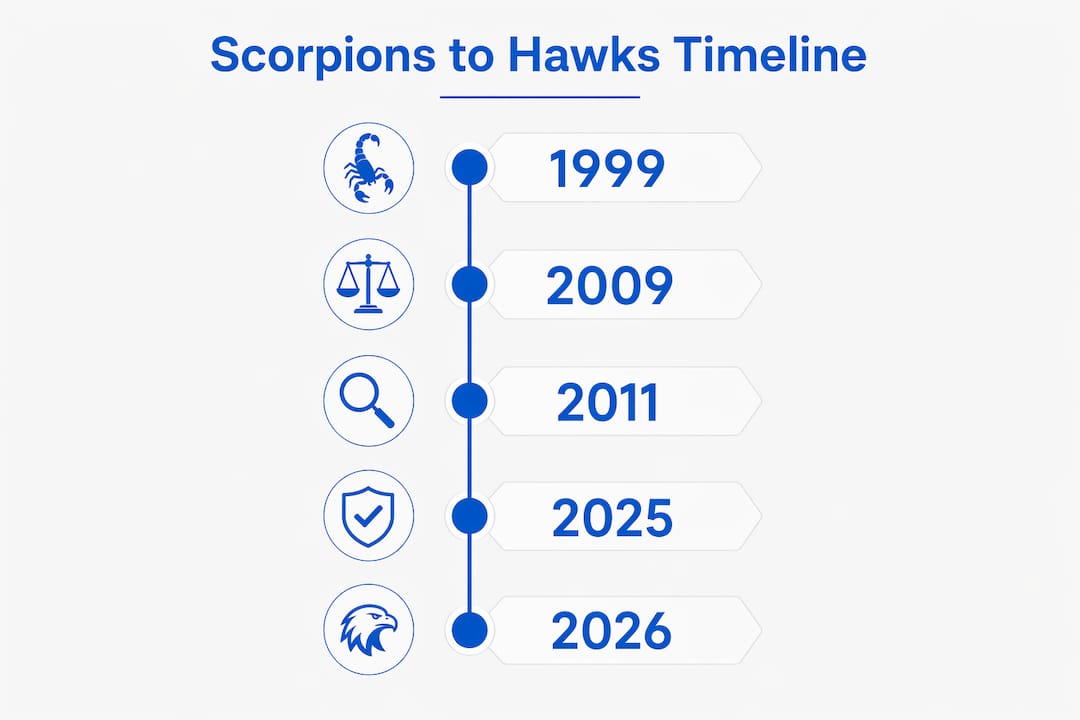
Timeline: from the Scorpions’ founding to today’s legal landscape
| Date | Event | Where to find the record |
|---|---|---|
| June 1999 | President Thabo Mbeki announces the Scorpions | Parliamentary Hansard; NPA founding documents |
| 1 September 1999 | DSO formally launched in Gugulethu | NPA legislative record |
| — | DSO legally and operationally active; renamed DSO | NPA gazette |
| December 2007 | ANC Polokwane conference resolution to disband Scorpions | ANC conference resolutions archive |
| October 2008 | National Assembly passes SAPS Amendment Act (a substantial majority vs opposition) | Parliamentary Hansard |
| January 2009 | Scorpions disbanded; Hawks become operational | SAPS Amendment Act 2008) |
| March 2011 | Constitutional Court (Glenister v President) rules Hawks unconstitutional on independence grounds | Constitutional Court judgment |
| — | Second Glenister challenge; Court strikes further provisions | Constitutional Court records |
| July 2025 | Former Chief Justice Zondo publicly criticises Hawks’ PRASA handling | News24 / Scrolla reporting |
| November 2025 | Acting Police Minister Cachalia calls 2009 disbandment “a mistake” | Daily Maverick |
The 2007 Polokwane resolution is the political pivot point. Everything after it flows from that decision, and the Constitutional Court’s 2011 ruling confirmed the structural problem the resolution created.
Why institutional structure determines accountability outcomes
The Scorpions’ placement inside the NPA was not incidental. Prosecutors joined investigations from day one, shaping evidence collection toward what would hold up in court. That integration shortened the path from arrest to conviction.
The Hawks’ placement inside SAPS reversed that logic. Investigators build a docket, then hand it to the NPA, which may decline to prosecute or request further investigation. Each handoff is a potential stall point, and each stall point sits closer to political oversight.
- Appointment and dismissal: The Hawks’ head is appointed by the Police Minister, creating a direct line of executive influence. The Scorpions’ leadership sat under the NDPP, one step further from ministerial control.
- Budget and HR: Hawks personnel are SAPS employees; their career progression depends on the police hierarchy, not prosecutorial outcomes.
- Search and seizure: Both units held these powers, but the Scorpions’ prosecutors could immediately assess seized material for evidentiary value.
- Political insulation: The Constitutional Court majority found the Hawks were “insufficiently insulated from political interference” because the Police Minister held effective authority over their operations.
Pro Tip: When examining a document from the archive, check the letterhead and reporting line first. A memo addressed to the NDPP signals a Scorpions-era file; one addressed to the National Commissioner of Police signals Hawks-era. That single metadata point tells you which accountability framework applies.
What the record shows: PRASA, Zondo, and Cachalia
The PRASA case is the clearest documented example of the Hawks’ limitations. The board of the Passenger Rail Agency of South Africa, chaired by Popo Molefe, lodged corruption complaints with the Hawks in 2017. Years later, no arrests had been made.
Acting Police Minister Firoz Cachalia went further in November 2025, stating the 2009 disbandment was a mistake and that South Africa’s current policing model lacks prosecution-led investigative capability. That an acting minister said this publicly signals the political consensus is shifting.
A caveat researchers must hold: the correlation between institutional change and worse outcomes does not prove single causation. To strengthen a causal claim, look for internal referral memos, docket opening dates, and prosecutorial decision records. These show precisely where a case stalled and under whose authority.
Which Madlanga Commission exhibits help you trace Scorpions and Hawks activity?
The Madlanga Commission’s archive is the most accessible primary source for researchers tracking police and prosecutorial failures in South Africa. High-value exhibit categories include:
- Witness testimony transcripts from serving and former Hawks investigators
- Internal investigation files showing referral chains and docket timelines
- Exhibit inventories such as the Aeroton cocaine haul and the red Kia Cerato, which illustrate chain-of-custody handling
- Official statements and rulings entered as exhibits during hearings
To navigate the archive:
- Start with the case files index to identify the case or actor you are researching.
- Open the relevant hearing day page (Days 113–124 cover recent testimony with exhibits).
- Use the exhibit inventory on each hearing page to locate specific documents.
- Cross-reference with NPA records, Constitutional Court documents, and Parliamentary Hansard for the full picture.
Cross-checking Commission exhibits against NPA prosecution records is particularly useful for identifying where a referral was made but prosecution did not follow.
How to track corruption cases using public records
- Identify the case name and key actors. Start with a person’s name, an organisation (e.g., PRASA), or a docket reference.
- Gather primary identifiers. Note the docket number, witness names, and hearing day from Commission records.
- Pull Commission exhibits. Use the key figures directory to match witnesses to testimony.
- Cross-reference with NPA and SAPS records. Request docket status via PAIA (Promotion of Access to Information Act) from the NPA records office or SAPS DPCI docket office.
- Log dates and referral chains. Build a timeline: when was the complaint lodged, when was the docket opened, when was a prosecutorial decision made?
For PAIA requests, scope them tightly: specify the docket number or case name, the date range, and the document type (referral memo, prosecutorial decision, exhibit inventory). Vague requests are routinely returned as too broad.
Pro Tip: Use your browser’s PDF text search (Ctrl+F) on Commission hearing transcripts to find a witness name or case reference across a long document. Pair this with the site’s own search function to cross-reference exhibit labels between hearing days.
What you can do right now
- File a PAIA request to the NPA records office or SAPS DPCI docket office for a specific case’s docket status and referral history.
- Lodge a complaint with the Independent Police Investigative Directorate (IPID) if you have evidence of investigative misconduct or deliberate delay.
- Contact the Parliamentary Portfolio Committee on Police secretariat to flag cases that appear to have stalled without explanation.
- Engage investigative journalists at outlets covering the Commission; they can corroborate findings and apply additional pressure.
- Preserve chain-of-custody information before sharing any evidence publicly. Do not interfere with active investigations; consult a legal practitioner if you are unsure whether sharing a document could compromise a prosecution.
Pro Tip: When writing a PAIA request, cite the specific section of the PAIA Act that covers the record type you need. Requests that reference the correct statutory provision are harder to deflect on procedural grounds.
Recommendations for reform and next steps
The evidence points to three structural fixes that researchers and civil society can advocate for:
- Restore prosecutorial independence for high-level corruption investigations, either by returning a specialist unit to the NPA or by creating a statutory firewall between the Hawks’ leadership and the Police Minister.
- Strengthen DPCI independence through appointment criteria and dismissal safeguards that require Parliamentary approval, not just executive sign-off.
- Mandate transparent referral tracking so that every case lodged with the Hawks generates a public record of its status at investigation, referral, and prosecution stages.
Researchers and civil society can advance these through evidence briefs submitted to Parliamentary portfolio committees, targeted PAIA requests that build a documented record of stalled cases, and formal petitions citing the Constitutional Court’s own language on independence.
The one-sentence verdict: South Africa’s anti-corruption capacity weakened when the Scorpions were replaced by a police-embedded unit, and restoring prosecution-led investigative independence is the clearest path back to accountability.
Key takeaways
The Scorpions’ prosecution-anchored model produced measurably different accountability outcomes than the Hawks’ police-embedded structure, and the Madlanga Commission archive is the primary public resource for tracing that difference case by case.
| Point | Details |
|---|---|
| Scorpions vs Hawks are distinct | Conflating them as “scorpion hawks” obscures which institutional model was responsible for a case outcome. |
| Institutional home determines independence | Scorpions sat inside the NPA; Hawks sit inside SAPS, closer to executive control and the Police Minister. |
| Constitutional Court confirmed the problem | The 2011 Glenister ruling found the Hawks insufficiently independent and ordered Parliament to fix the legislation. |
| PRASA is the benchmark case | Complaints lodged with the Hawks in 2017 had produced no arrests years later, per Zondo’s July 2025 statement. |
| Madlanga Commission is your starting point | The archive’s case files, exhibit inventories, and hearing day pages provide primary-source evidence for tracing investigative failures. |
Why the archive is the accountability record that matters
Public records only serve accountability when people can actually find and use them. The Madlanga Commission was designed around that premise: every hearing day, every exhibit, every witness profile is indexed and searchable so that a researcher in Johannesburg or a citizen in Cape Town can follow the same evidence trail that a lawyer in the hearing room can. The Commission’s work transforms dense testimony into navigable data, making it possible to verify claims independently rather than relying on official summaries. That is not a minor convenience. When institutions fail, the public record is often the only check left.
The Madlanga Commission archive: where to start
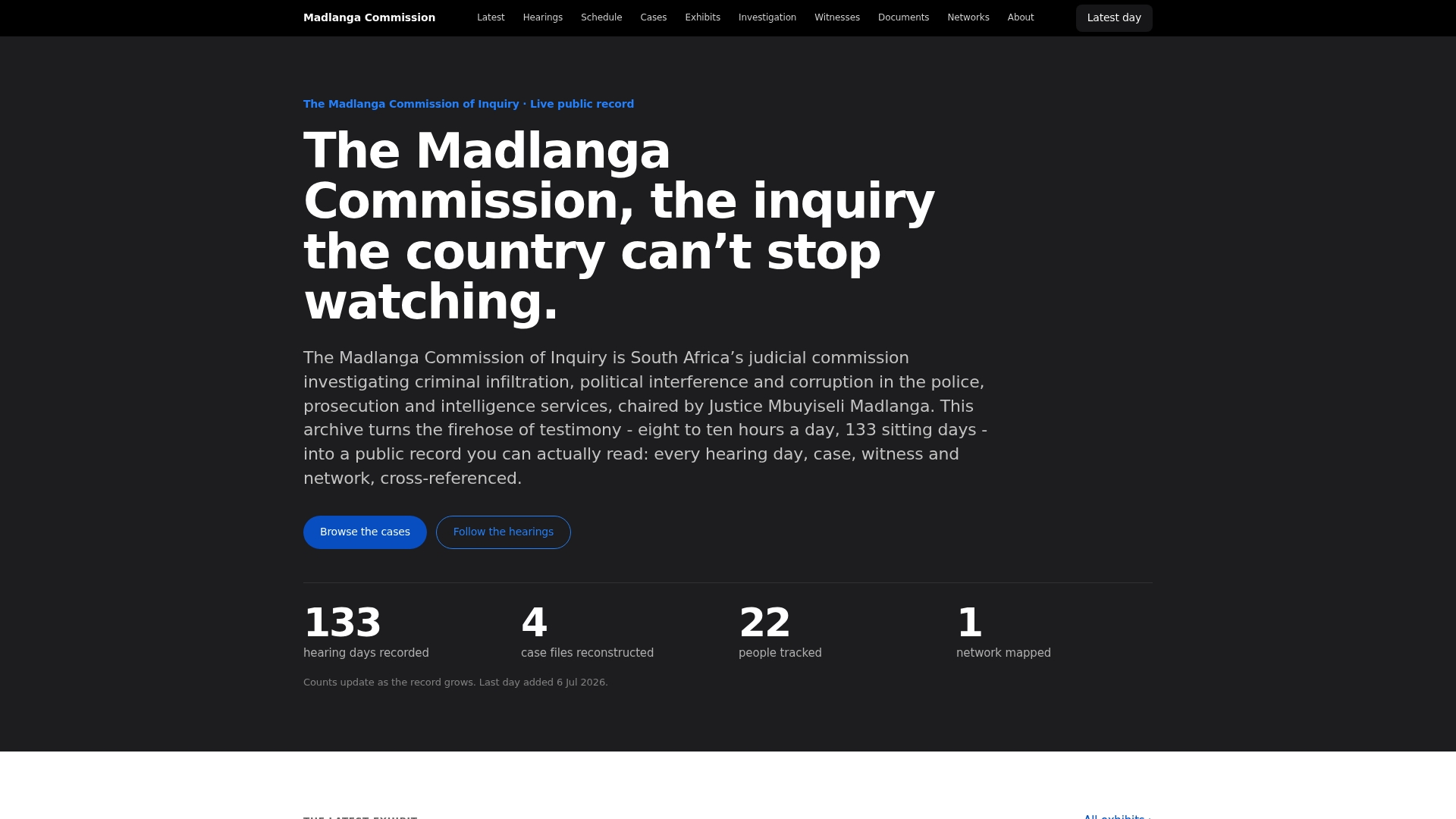

The Madlanga Commission’s archive is free, public, and built for exactly this kind of research. Start with a recent hearing day: Day 115 (8 June 2026), Day 118 (11 June 2026), or Day 124 (23 June 2026) each contain transcripts, exhibit inventories, and witness statements you can search immediately. The exhibits index on each hearing page is organised by case and document type, so you can move from a witness name to a specific document in a few clicks. Bookmark the Methodology, Sourcing & Corrections page to understand how the archive is maintained and how to cite exhibits in submissions or reports. For researchers new to the Commission’s structure, the Explainers section walks through how to read transcripts and interpret exhibit labels. Open a hearing day page now and search for a case name you already know.
Selected primary sources and further reading
- Constitutional Court, Glenister v President and others (2011): The foundational legal text on Hawks independence. The majority judgment by Moseneke and Cameron is the document to cite when arguing for structural reform. Find it via the Constitutional Court’s online judgment database.
- SAPS Amendment Act 2008: The legislation that created the Hawks and disbanded the Scorpions. Parliamentary Hansard records the October 2008 vote (252 in favour, 63 opposed).
- South African Crime Quarterly, “Countering corruption in South Africa: The rise and fall of the Scorpions and Hawks”: The most cited academic overview of both units. Available via ASSAF journals.
- Madlanga Commission hearing days (Days 113–124): Primary testimony and exhibits on current investigations. Cross-reference exhibit labels between hearing days to build a complete evidence chain.
- Raymond Zondo, July 2025 public statement: Reported by News24 and Scrolla; cite alongside the PRASA docket timeline for a documented judicial assessment of Hawks performance.
- Firoz Cachalia, November 2025 (Daily Maverick): Executive-branch acknowledgement that the 2009 disbandment was a mistake; useful in policy submissions arguing for structural reform.
To cite a Commission exhibit in a research submission, note the hearing day number, the date, the exhibit label, and the witness who introduced it. That four-part reference is sufficient for Parliamentary committee submissions and academic footnotes alike.
FAQ
What is the difference between the Scorpions and the Hawks?
The Scorpions (DSO) were a prosecution-led unit inside the NPA (1999–2009); the Hawks (DPCI) are a police unit inside SAPS. The core difference is institutional home: the Scorpions could initiate prosecutions directly, while the Hawks must refer cases to the NPA.
Was disbanding the Scorpions unconstitutional?
The Constitutional Court ruled in 2011 that the legislation creating the Hawks was unconstitutional on independence grounds, and gave Parliament 18 months to remedy it. The Court did not reinstate the Scorpions but required stronger statutory safeguards for the Hawks.
Where can I find primary evidence on stalled corruption cases?
The Madlanga Commission archive at madlangacommission.co.za hosts hearing day transcripts, exhibit inventories, and witness profiles. Start with the case files index and cross-reference with NPA and Parliamentary records via PAIA requests.
What did Raymond Zondo say about the Hawks in 2026?
In July 2025, former Chief Justice Zondo stated publicly that his faith in the Hawks is not the same as his faith in the Scorpions, citing PRASA corruption complaints lodged in 2017 that had still produced no arrests.
What is “scorpion hawks” and why does the term matter?
“Scorpion hawks” conflates two separate units with different mandates and legal structures. Academic and policy literature treats the conflation as analytically harmful because it obscures which institutional model was responsible for a given case outcome.
This article provides general information for research and civic purposes. It is not legal advice. Confirm current legal frameworks and procedural requirements with a qualified legal practitioner or the relevant primary source before acting on any information here.