Commission evidence rules in South Africa explained

A commission of inquiry in South Africa is not a court, so it does not apply court rules of evidence in the strict sense. It can summon witnesses, take evidence under oath and call for documents, and it may consider material a trial court would keep out, hearsay included. What protects witnesses and implicated people is procedural fairness, the privileges that apply in a criminal trial, and the possibility of judicial review. This guide explains how those pieces fit together and how to see them at work in the Madlanga Commission record.
TL;DR
- A commission is an investigative body, not a court. It is not bound by the same rules of evidence as a court and may consider evidence it finds relevant.
- The Commissions Act, 1947 gives a commission court-like powers to summon witnesses, administer oaths, examine witnesses and call for books, documents and objects.
- Flexibility has limits: privileges that apply in a criminal trial still apply, and people implicated must get a fair chance to respond.
- Findings are generally recommendations. Legal consequences follow when the appointing authority, such as the President, acts on them.
Table of Contents
- Which laws govern evidence before a commission?
- What powers does a commission have over witnesses and documents?
- Are commissions bound by court rules of evidence?
- Hearsay, corroboration and weight
- Privilege and the right to refuse
- Procedural fairness: the real constraint
- What are a commission’s findings worth?
- How to follow the evidence in the Madlanga Commission
- Where to find the full Madlanga record
- Our perspective: why evidence rules should be read, not feared
- FAQ
- Sources
Which laws govern evidence before a commission?
Three layers apply to a South African commission of inquiry.
The first is the Constitution, which sets the standards of legality, rationality and fair procedure that any exercise of public power must meet. The second is the Commissions Act, 1947 (Act 8 of 1947), the statute that gives a commission its procedural muscle. It also deals with matters such as the commission’s sittings, public sittings, obstruction of a commission and offences by witnesses. The third is the commission’s own terms of reference and regulations, issued when the President appoints it. These set the subject matter, the time frame and often the detailed hearing procedure.

The Act is short. It does not contain a code of evidence. That silence is deliberate: the Act says what a commission can compel, and leaves the commission to decide what it will treat as useful.
For how the Madlanga Commission fits into this family of bodies, see our overview of judicial commissions in South Africa and the explainer on what the Madlanga Commission is.
What powers does a commission have over witnesses and documents?
Section 3(1) of the Act is the core. For the purpose of ascertaining any matter relating to its investigations, a commission has the powers a Provincial Division of the Supreme Court has within its province: to summon witnesses, to cause an oath or affirmation to be administered to them, to examine them, and to call for the production of books, documents and objects.
In practice that means four things:
- Summons. A person can be required to attend and testify, or to bring documents.
- Oath or affirmation. Evidence is given under oath or affirmation, which is why lying to a commission carries legal risk.
- Examination. The commission, through its evidence leaders and the chairperson, can put questions to the witness.
- Production. Records, books and objects can be demanded, which is how exhibits reach the public record.
The Constitutional Court has confirmed the practical consequence: a witness summoned to a commission is obliged to give evidence and answer questions, subject to the privileges that apply to a witness in a criminal trial under section 3(4) of the Act. That is the key balance. The commission can compel, but the witness keeps the protections the law of privilege gives in criminal proceedings.
Section 3(4) also entitles a summoned witness to the same witness fees from public funds as a witness at a criminal trial in a superior court, and states that the law of privilege applicable to a witness in such a trial applies to evidence or documents produced before the commission.
Are commissions bound by court rules of evidence?
No. UCT’s analysis of the difference between inquiries and courts states that a commission is not bound by the same rules of evidence as a court and may consider evidence it finds relevant. Warren Freedman, writing in Obiter in 2022, makes the same point: commissions are not courts, they collect their own evidence and are not bound by court rules of evidence.
The reason is the job. A court decides a dispute between parties on the case they bring. A commission investigates, usually on a matter of public concern, and the commission itself, through its evidence leaders, finds the facts. If it applied every exclusionary rule, it could miss the very material it was appointed to examine.
What this looks like in a hearing
A court asks, “Is this admissible?” A commission more often asks, “Is this relevant, and how much weight does it deserve?” The practical results:
- A witness can describe what they were told by someone else, and the commission can hear it, while still deciding how far to rely on it.
- Documents can be handed up as exhibits and read into the record without a formal witness for each page.
- The sequence is led by the commission’s own team rather than by two opposing parties.
Hearsay, corroboration and weight
The general approach in the Obiter article is that commissions need not follow court rules of evidence and may consider hearsay. In a criminal court, hearsay is generally inadmissible unless an exception applies. Before a commission, the question moves from admissibility to reliability.
That shift matters for how you read a transcript. When a witness says “I was told that”, the statement is not proof of the underlying fact. It is a lead the commission can test by calling the person who made the statement, asking for a document, or comparing it with other testimony.
Corroboration works the same way. In a trial it is a rule of caution that courts apply to certain categories of evidence. A commission is not required to apply that technical rule, but the sensible investigator still looks for independent confirmation, because a finding resting on one uncorroborated account is easy to attack on review.
A practical reading method:
| Type of material | How to read it |
|---|---|
| Direct testimony from a witness with personal knowledge | Strongest oral evidence, still tested in cross-examination |
| Second-hand account (hearsay) | A lead, not proof, until confirmed |
| Documents and exhibits | Check authorship, date and whether a witness identified them |
| Affidavits and statements | Read with the oral evidence that follows, where they differ |
| Media reports or opinion | Context only |
Privilege and the right to refuse
Compulsion is not unlimited. Under section 3(4), privilege as it applies in a criminal trial carries over. The best-known example is the privilege against self-incrimination: a witness may decline to answer a specific question where the answer would expose them to criminal liability, though the objection must be raised about the question, not used as a blanket refusal to attend.
Legal professional privilege protects confidential communications between lawyer and client. Both must be claimed and assessed question by question. If you are summoned and think privilege applies, speak to an attorney or advocate before the hearing, not on the day, because the commission can rule on the claim and the way it is raised affects the outcome.
Witnesses who may later face prosecution, or who cooperate with the State, have additional questions. Our guide to state witnesses in South Africa covers the legal limits, and our piece on evidence in inquiries sets out what witnesses must know.
Procedural fairness: the real constraint
Relaxed evidence rules do not mean relaxed fairness. Obiter’s analysis notes that procedural fairness is flexible and depends on the circumstances. A commission looking at routine administrative failures owes less than one that may make adverse findings about named individuals.
The UCT analysis adds the most practical point: people implicated need enough time to respond to allegations for a commission’s decisions to be seen as fair. In practice fairness usually involves:
- Notice of the allegations that concern the person.
- Access to the evidence relied upon, in time to prepare.
- A real opportunity to give an answer, to testify and to challenge adverse evidence.
- A decision-maker who has not prejudged the matter.
The broader field of administrative fairness is explained in our guide to administrative justice in South Africa.
What are a commission’s findings worth?
A commission does not issue judgments. Its findings are typically non-binding recommendations, and legal effect arises when the appointing authority, such as the President, acts on them. Criminal charges, disciplinary action or policy reform are separate steps taken by the National Prosecuting Authority, employers, Parliament or the executive.
Courts can still review a commission. According to the same UCT source, South African courts have reviewed commission decisions using the principles of legality and rationality, asking whether the decision is connected to a legitimate governmental purpose and was reached through a fair procedure. So a commission’s loose approach to evidence is not a free pass. A finding built on a procedure that denied someone a fair hearing can be set aside.
This also explains why commission evidence is not automatically usable in a criminal trial. Prosecutors usually need to build their case through the courts’ own admissibility rules, which is one reason a commission record and a criminal docket are different things.

How to follow the evidence in the Madlanga Commission
Knowing the rules helps you read the record critically. When you open a day’s hearing, ask:
- Who is the witness, and what is their personal knowledge?
- Is the statement first-hand or reported?
- Which exhibit supports it, and who authenticated it?
- Did anyone implicated get to respond?
- Were any privilege objections raised, and how did the chairperson rule?
For access to hearings themselves, see our guide to public access hearings.
Where to find the full Madlanga record
The Madlanga Commission archive turns lengthy hearings into a navigable public record: daily hearing records, witness profiles, exhibits, rulings, statements and media briefings, cross-referenced so you can move from a witness to their testimony to the documents they discussed.
Start in The Investigation Room, which maps how witnesses, cases and evidence connect. If you want to see how a prominent witness’s evidence sits in the record, open the profile of Bheki Cele or Dr Ntandazo Sifolo. Access is free.
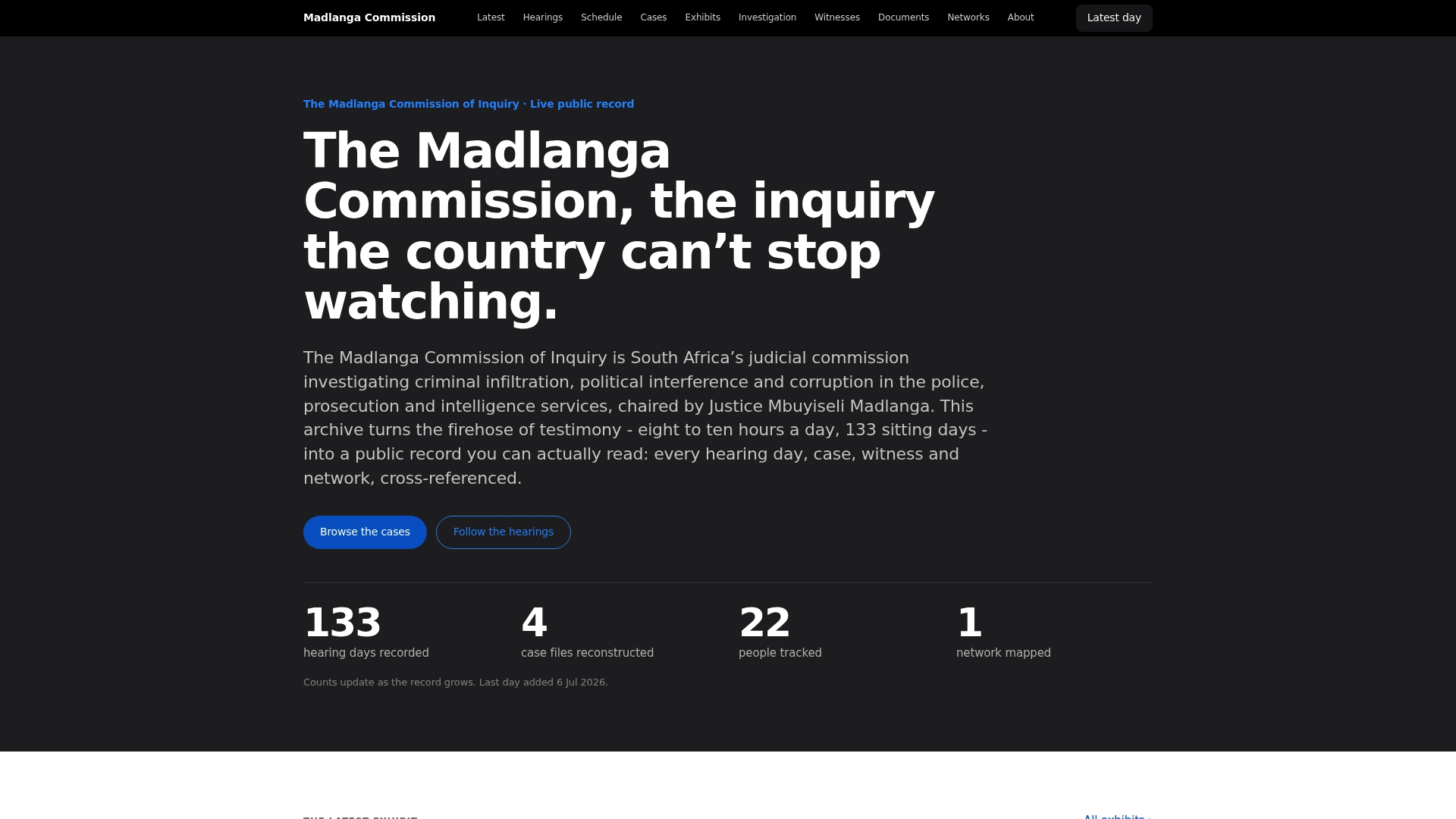
Journalists and researchers can use the cross-references to check a claim against the exhibit it rests on. Citizens can follow developments without sitting through live feeds.
Our perspective: why evidence rules should be read, not feared
We built this archive because the rules of evidence before a commission are widely misunderstood. People hear that hearsay is allowed and conclude that anything goes. Others hear that a commission is “not a court” and conclude it has no teeth. Both are wrong.
What we see in the record is a process in which flexibility is paired with testing. A witness’s account is put against documents, other witnesses and the chronology. Weight is earned by corroboration and by surviving challenge. The public, journalists and legal professionals can only judge that if the material is organised so that each claim leads back to its source.
Our view is that the most useful thing an archive can do is keep the distinction visible between what a witness said, what a document shows, and what the commission eventually finds. Allegations are not findings, and findings are not convictions. If you remember that when you read a transcript, you will read it better than most commentary does.
— Meriol Lainchyon
FAQ
Can a commission of inquiry force me to testify?
Yes. Under the Commissions Act, a commission has the power to summon witnesses and examine them under oath, and the Constitutional Court has confirmed that a summoned witness must give evidence and answer questions. You keep the privileges that apply in a criminal trial. If you are summoned, get legal advice before the hearing date.
Is hearsay allowed at a commission?
Commissions are not bound by court rules of evidence, so they may consider hearsay. The question becomes how much weight it deserves. Second-hand accounts are normally tested against documents or first-hand witnesses.
Are commission findings legally binding?
Generally not. Findings are recommendations, and legal effect arises when the appointing authority, such as the President, acts on them. Prosecutions and disciplinary steps are separate processes run by other bodies.
Can a commission’s decisions be challenged in court?
Yes. Courts have reviewed commission decisions on the principles of legality and rationality, looking at whether the decision served a legitimate purpose and followed a fair procedure. If an implicated person was not given enough time to respond, that is a ground on which the process can be questioned. Anyone considering this should see an attorney promptly.
Where can I read what witnesses actually said?
The Madlanga Commission archive holds hearing records, witness profiles, exhibits and rulings in one searchable place. Begin with The Investigation Room and follow the links from a witness to their evidence.
Sources
- Commissions Act, 1947 (Act 8 of 1947), government copy
- Commissions Act, 1947, section 3: Commission’s powers as to witnesses
- Commissions of inquiry vs courts of law, UCT News (2018)
- Commissions of inquiry and the rules of evidence, Obiter (2022)
- Constitutional Court of South Africa judgment (2021)