Contempt of Inquiry in South Africa: What the Law Says

South African law has no single offence called “contempt of inquiry”. What people usually mean is a set of crimes under the Commissions Act 8 of 1947, such as ignoring a summons, refusing to answer, lying under oath or wilfully obstructing a commission, plus the separate route of contempt of court when someone defies a court order linked to a commission. The penalties in the Act are modest on paper, but the 2021 Constitutional Court ruling against Jacob Zuma showed that defiance of an inquiry can end in a prison sentence by another door.
TL;DR
- A commission of inquiry cannot punish anyone itself. Non-compliance is an offence under the Commissions Act, prosecuted in the ordinary criminal courts.
- The main offences are failing to attend or remain, refusing an oath, not answering lawful questions, not producing documents, giving false evidence and wilfully hindering or interrupting the commission.
- A witness who stays away must prove “sufficient cause”. The burden is on the witness, not the state.
- Contempt of court is a different mechanism: it arises when a court order, for example an order to appear before a commission, is disobeyed.
- Newer commissions can have their own regulations that add offences, such as insulting the chairperson or leaking confidential material.
Table of Contents
- What a commission of inquiry is, and why the law protects it
- The offences in the Commissions Act
- Penalties: what the Act actually provides
- Extra offences in commission regulations
- Contempt of inquiry versus contempt of court
- Duties of a witness, and what “sufficient cause” can mean
- How a contempt matter typically unfolds
- Our perspective
- Follow non-compliance matters in the record
- Practical checklist for readers
- FAQ
- Sources
What a commission of inquiry is, and why the law protects it
A commission of inquiry is a fact-finding body. The Commissions Act applies, by proclamation, to a commission appointed to investigate a matter of public concern. Unlike a court, it does not decide a dispute between two sides and does not hand down binding rulings on anyone’s rights. The SANEF guide for court reporters describes the difference simply: a commission is inquisitorial, a court is adversarial.
That is exactly why the law backs it with criminal sanctions. A commission can only find facts if people turn up, answer and hand over documents. In its 2021 judgment the Constitutional Court stressed that commissions are essential for gathering information to shape public policy and to deal with matters of public concern, and that criminalising obstruction is part of what shields them from outside interference.
The same judgment confirms that section 3 of the Act gives a commission powers equal to those of a High Court to summon witnesses, administer oaths and demand documents. A commission that investigates policing can also summon police officers. In an earlier case the Constitutional Court held that a commission under section 206(5) of the Constitution has an implied power to subpoena members of the police, and that this power does not amount to controlling or managing the Police Service.

The offences in the Commissions Act
Two sections do most of the work: section 5 on hindering a commission and section 6 on offences by witnesses. Read together, they cover the following.
| Conduct | Offence | Where it sits |
|---|---|---|
| Wilfully interrupting proceedings | Obstruction offence | Section 5 |
| Wilfully hindering or obstructing the commission in its functions | Obstruction offence | Section 5 |
| Failing to attend, or to remain until the inquiry ends or you are excused | Witness offence, unless you prove sufficient cause | Section 6(1) |
| Refusing to take an oath or affirm when required | Witness offence | Section 6(1) |
| Not answering lawfully put questions fully and satisfactorily | Witness offence | Section 6(1) |
| Not producing a summoned book, document or object | Witness offence | Section 6(1) |
| Knowingly giving false evidence | Witness offence | Section 6 |
All of this is set out in the text of the Act on LawLibrary. Two details matter in practice.
First, the word “wilfully”. Section 5 does not criminalise an awkward question, a heated exchange or an honest mistake. It targets deliberate interruption or obstruction.
Second, “without sufficient cause”. For the attendance and answering duties, the Act says the onus of proof rests on the person summoned. The state does not have to disprove your reason. You have to establish it.
Penalties: what the Act actually provides
The Act was written in pounds, and it has never been restated in rand. Offences carry a fine of up to fifty pounds or imprisonment of up to six months, or both, or, for the more serious offences, a fine of up to one hundred pounds or imprisonment of up to twelve months, depending on the offence. Section 5 obstruction and the section 6(1) summons failures fall in the six-month tier, according to the Act.
Three points follow from this.
- A conviction needs a prosecution. The commission refers the matter, and the National Prosecuting Authority decides whether to charge. The inquiry itself cannot arrest or sentence.
- Fines are not the real deterrent. A criminal record and up to a year in prison are.
- Enforcement can be slow. Reporting by IOL’s Cape Times noted that a businessman who failed to appear before the Madlanga Commission had still not faced legal consequences weeks after the commission announced it would lay a criminal charge under the Commissions Act.
Extra offences in commission regulations
The Act is the base layer. A president who appoints a commission can also publish regulations that set its working rules, and these can create further offences. The regulations for the 2025 judicial commission into the Truth and Reconciliation Commission cases, published in the Government Gazette, criminalise insulting or belittling the chairperson and forbid unauthorised disclosure of confidential information or documents. Regulation 12 attaches penalties of up to six or twelve months’ imprisonment depending on the offence, whether it is obstructing the commission or breaching secrecy.
The practical lesson: always read the regulations for the specific commission in front of you, not just the 1947 Act. Journalists, in particular, should check what a commission’s regulations say about confidential documents and witness identities before publishing.
Contempt of inquiry versus contempt of court
The two are often confused, and the confusion is understandable because the Zuma case involved both.
Contempt of court is a common-law wrong. South African law defines it as the unlawful and intentional violation of the dignity, repute or authority of a judicial body or officer. In the specific form that matters here, it arises when a person disobeys a court order. A court order is needed, it must be served or known to the person, and the person must have failed to comply. The applicant in the Zuma matter put those requirements to the Constitutional Court and argued that once they are shown, contempt is established unless the respondent raises a reasonable doubt about wilfulness and bad faith.
| Contempt of inquiry (Commissions Act) | Contempt of court | |
|---|---|---|
| Source | Statute: sections 5 and 6 of the 1947 Act, plus any commission regulations | Common law, enforced by the courts |
| Trigger | Ignoring a summons, refusing to answer, obstruction, false evidence | Disobeying a court order |
| Who acts | The commission refers the matter, prosecutors decide whether to charge | The court that issued the order |
| Penalty | Fine or up to six or twelve months, depending on the offence | Committal to prison or a fine, set by the court |
The link between the two is a court order. In the Zondo Commission, the commission first went to the Constitutional Court for an order directing the former president to appear. When he defied it, the Court held him in contempt. The sanction came from the court-order route, not from section 6 of the Commissions Act.
Duties of a witness, and what “sufficient cause” can mean
If you are summoned, you must attend, stay until the inquiry ends or you are excused, take an oath or affirm if required, answer lawful questions fully and satisfactorily, and produce what the summons lists. Failing to do so is an offence unless you prove sufficient cause.

The Act does not define sufficient cause, so it is decided case by case. Reasonable examples a court would weigh include genuine illness supported by medical evidence, a defect in the summons, or a lawful objection to a particular question. What does not help is silence about your reasons: if you cannot attend, tell the commission’s secretariat or legal team in writing, early, with evidence.
You also keep your rights. Witnesses are entitled to the privileges that apply to witnesses in a criminal trial in a superior court, and a police witness may raise any lawful objection to producing particular evidence, as the Constitutional Court said in 2013. The most important of these for many witnesses is the protection against self-incrimination. Our article on self-incrimination in the Madlanga Commission inquiry explains how that privilege interacts with the duty to answer, and evidence in inquiries: what witnesses must know covers what to expect when you give testimony.
A person who is both a witness and potentially exposed to charges has a harder path. If that is you, see an attorney or advocate before the hearing, not after a summons has been ignored. Our guide to being a state witness in South Africa sets out the wider legal position and protection options.
How a contempt matter typically unfolds
- A summons or directive is issued under the commission’s powers, naming the date, place and any documents.
- The person does not comply, and gives no reason, or one the commission does not accept.
- The commission decides on a route. It can refer the failure to prosecutors as a Commissions Act offence, or, where a court order is needed and then defied, approach a court.
- A court decides. Under the Act, a criminal court must find the offence proven, with the onus on the witness to show sufficient cause. In a contempt of court application, the court looks at the order, service or knowledge, and non-compliance, then at wilfulness and bad faith.
- Sanction follows, within the limits of the Act or the court’s own powers.
Because step 3 depends on prosecutors and courts, there is often a gap between a public announcement that charges will be laid and any outcome. Readers tracking a live matter should rely on the record rather than on early headlines.
Our perspective
We built this archive because the hardest part of any inquiry for ordinary people is not access to a livestream, it is making sense of what was said, by whom, and under what legal compulsion. Contempt questions show why that matters. When a witness fails to appear, the real story sits in the details: which summons, which date, which directive, what reason was offered and what the commission did next.
Our view is that the law here works best when people can see it work. Commissions depend on compliance, but witnesses also deserve clarity about their duties and their privileges. A public record that ties each summons, ruling and statement to the person and the hearing day lets citizens, journalists and lawyers check claims instead of repeating them. That is why we keep rulings, statements and witness profiles cross-referenced and searchable.
We do not give legal advice. If you are summoned, speak to a lawyer. If you are reporting on one, read the primary documents first.
— Meriol Lainchyon
Follow non-compliance matters in the record
If you are tracking whether a witness appeared, what directive was issued, or what the commission said about non-attendance, you do not need to watch hours of footage. The Madlanga Commission archive collects daily hearing records, rulings, statements, exhibits and witness profiles in one searchable place, free to use.
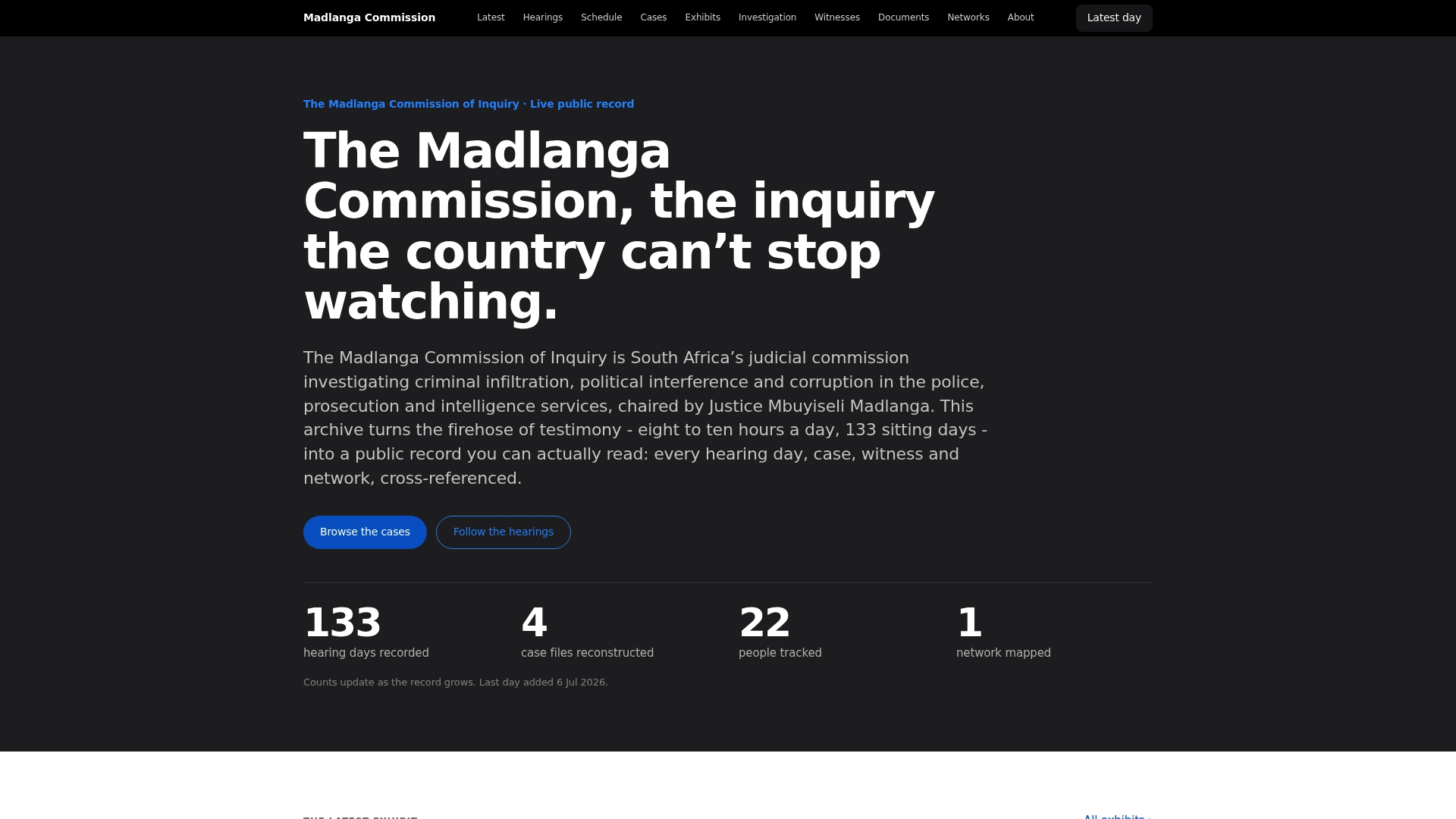
Start in The Investigation Room to follow witnesses, evidence and official documents side by side.
Practical checklist for readers
If you are a witness or have been summoned
- Read the summons closely for date, venue, documents and any conditions.
- Get legal advice before the hearing, especially if your own conduct may be questioned.
- If you cannot attend, say so in writing, early, with proof of the reason.
- Raise objections to specific questions or documents on the record, rather than by silence.
If you are a journalist or researcher
- Cite the section of the Act or the regulation, not a general label such as “contempt”.
- Separate what a commission has announced from what a court has decided.
- Check the commission’s regulations for confidentiality limits before publishing.
If you are a citizen following events
- Look for the primary document: the ruling, directive or gazette notice.
- Remember that a referral for prosecution is not a conviction.
FAQ
What is the penalty for contempt of a commission of inquiry in South Africa?
Under the Commissions Act, the main offences carry a fine of up to fifty pounds or imprisonment for up to six months, or both. Some offences carry a fine of up to one hundred pounds or up to twelve months in prison. Commission regulations can add their own offences with similar penalty ranges. If the matter becomes contempt of court, the court sets the sanction.
What is meant by a commission of inquiry?
It is a body appointed by the President to investigate a matter of public concern and report with findings and recommendations. It gathers facts and does not decide cases between opposing parties. The Commissions Act gives it the powers to summon witnesses, take evidence under oath and require documents.
Can a commission of inquiry arrest someone who ignores a summons?
No. The commission refers the failure to prosecutors, who decide whether to charge under the Act, or it asks a court for an order. Only the criminal courts can convict, and only a court can punish contempt of court.
What defence does a witness have?
The Act allows a witness to prove sufficient cause for not attending, remaining, answering or producing. The witness carries that burden. Witnesses also keep the privileges of a criminal trial witness in a superior court, including lawful objections to particular questions or documents.
Is contempt of inquiry the same as contempt of court?
No. One rests on the Commissions Act and any commission regulations, the other on disobeying a court order. They can connect: in the Zuma matter, the Constitutional Court order to appear before the Zondo Commission was ignored, and the contempt of court sanction followed.
Sources
- Commissions Act 8 of 1947, LawLibrary
- Secretary of the Judicial Commission of Inquiry v Zuma (2021) ZACC 2
- Secretary of the Judicial Commission of Inquiry v Zuma (2021) ZACC 18
- Constitutional Court judgment CCT 52/21, judiciary.org.za
- Constitutional Court judgment (2013) ZACC 33
- Commission regulations, Government Gazette 2025
- SANEF guide: Commissions of inquiry
- IOL Cape Times: Why the Madlanga Commission cannot arrest witnesses who ignore subpoenas