Gang infiltration of the police in South Africa: what the record shows

Gang infiltration of the police means criminal groups gaining access to, or influence over, officers, commanders and the justice system, so that investigations can be leaked, stalled or steered. In South Africa this is no longer only a suspicion. A High Court judgment, a provincial ombudsman report and sworn testimony before the Madlanga Commission and a parliamentary committee have all put the claim on the public record. Much of it is still allegation, and some of it is still being investigated. This guide separates what has been found from what has been alleged, and shows you where to read the original documents.
TL;DR
- A 2022 Western Cape High Court judgment found evidence that the 28s gang had penetrated senior SAPS management in the province and reached sensitive crime-prevention material.
- In November 2025 Premier Alan Winde released an ombudsman report that substantiated complaints about the provincial police commissioner and his senior management regarding gang links.
- Senior officers have told the Madlanga Commission and Parliament that syndicates have infiltrated the police and justice system beyond one province. These are allegations that are being tested.
- IPID has confirmed an investigation into gang infiltration in the Western Cape, and it remains unclear whether individual officers have been held to account.
- You can follow the hearings, witnesses and exhibits without watching the live feed.
Table of Contents
- What infiltration of the police actually means
- The court finding: the 28s gang and Western Cape police management
- The ombudsman report released in 2025
- What the Madlanga Commission and Parliament have heard
- How networks are alleged to work with officers
- Why it matters: investigations, prosecutions and public trust
- What has followed, and what is unresolved
- Perspective
- Follow the evidence yourself
- How to read infiltration claims critically
- FAQ
- Sources
What infiltration of the police actually means
The word is used loosely, so it helps to be precise. In the public debate it covers four different things:
- Corrupted individuals. An officer takes money or favours to leak information, lose dockets or warn a suspect before a raid.
- Compromised commanders. A senior officer, rather than a constable, is the point of contact. This is far more damaging, because commanders control resources, transfers, intelligence and which cases are prioritised.
- Planted or recruited people. A group encourages its members or associates to join the service, or recruits serving members into its network.
- Capture through business. Syndicates build relationships with officials through contracts and tenders, and the relationship then protects the criminal operation.
These are not the same, and a finding about one does not prove another. When you read a headline about “infiltration”, ask which of the four is being described, who found it (a court, an ombudsman, a witness under oath, a journalist), and whether it has been tested.
The court finding: the 28s gang and Western Cape police management
The firmest finding so far comes from a court. In October 2022 the Western Cape High Court, in a judgment by Judge Daniel Thulare, found evidence suggesting that senior SAPS management in the Western Cape had been penetrated by the 28s gang. According to the provincial government’s statement, this gave the gang access to sensitive crime-prevention strategies and to reports from the Anti-Gang Unit and Crime Intelligence.
The same judgment, as reported by Daily Maverick, said the gang had access to police management and sensitive reports, and that prosecutors faced threats to their lives and those of their families. That detail matters. Infiltration of the police does not stop at the police. When prosecutors are intimidated, the case collapses at the next stage of the chain.
The judgment arose from a criminal trial of alleged members of the 28s gang. Reporting from Cape Argus showed that the trial of 14 alleged 28s Mobsters in the Western Cape High Court reached its verdict stage in mid-2026. Check the latest reporting for the outcome.

The ombudsman report released in 2025
The Western Cape Police Ombudsman investigated complaints about gang links within the provincial police leadership. In November 2025, Premier Alan Winde released the report, after a public dispute over its release and redactions. According to Daily Maverick’s account, the ombudsman substantiated, on a balance of probabilities, complaints of unacceptable behaviour against the provincial police commissioner and his senior management regarding gang links.
Two cautions are needed here.
- “Balance of probabilities” is a civil standard. It is not a criminal conviction. The report is an oversight finding, not a verdict in a criminal court.
- The report is a Western Cape matter. The provincial government’s oversight role is limited, and the police are a national service. That is why the same coverage describes pressure on SAPS and on the Independent Police Investigative Directorate (IPID) to act.
What the Madlanga Commission and Parliament have heard
The Madlanga Commission was set up to look at criminal infiltration, political interference and corruption in the police, prosecution and intelligence sectors. Its hearings, and the parallel parliamentary ad hoc committee, have put much more testimony on the table, and the infiltration claims now stretch beyond the Western Cape.
In September 2025 a senior police official took the stand to say that criminal syndicates had infiltrated the police and justice system across provinces, and later testimony from Lt Gen Dumisani Khumalo went further. The same IOL report records him raising concern that people who order and organise hits were recruiting individuals serving in the criminal justice system, including the SAPS, and that this infiltration reached the highest levels. Those are his statements, made under oath, and the people he names have their own rights to respond.
Khumalo’s written statement to the parliamentary committee sets out the same worldview in detail. In it he alleged that leaked WhatsApp messages showed organised crime influencing SAPS and the Ekurhuleni Metropolitan Police Department at the highest levels to frustrate investigations, including procurement fraud involving contracts worth R360 million.
For a reader trying to follow the story, the key point is that these are claims presented to a commission or committee. A commission’s task is to test them, hear the other side and make findings. Until it does, report them as allegations.

How networks are alleged to work with officers
The testimony describes a pattern rather than a single scheme. Three features recur.
Relationships before payments
Khumalo’s statement says syndicates cultivate relationships with politicians, law-enforcement officers and business leaders to reach sensitive information and to manipulate or obstruct legal proceedings. The value to a gang is information: who is being investigated, when a raid is planned, which docket is on whose desk.
Legitimate business as cover
The same statement describes cartels as highly organised networks that blend illicit operations with legitimate businesses, using what he calls “tenderpreneurship” to launder money and win government contracts that cement their influence. A tender is also a relationship. Once a gang-linked business holds a state contract, the officials who awarded it have a reason to protect it.
Targeting the top
Reporting on the testimony before committees and commissions suggests cartels deliberately target senior political and law-enforcement figures to build “long-term resilience” against law enforcement. Compromising a commander is more efficient than compromising fifty constables.
The alleged gang boss Ralph Stanfield is one of the names that readers often connect with this debate. Our profile, Ralph Stanfield and the justice test, sets out what is on the record about him. The crime intelligence angle has its own history: see our explainer on Richard Mdluli and Crime Intelligence corruption.
Why it matters: investigations, prosecutions and public trust
Infiltration does damage in a sequence.
- Investigations. If a suspect learns of an operation in advance, it fails, and the investigators learn the leak came from inside.
- Prosecutions. Threats against prosecutors, as described in the 2022 judgment, make it harder to take cases to court and to keep them there. Our guide to what the National Prosecuting Authority does explains how this link in the chain works.
- Public safety. Where gangs hold territory, as they do in parts of the Cape Flats, residents see arrests that do not stick and operations that seem to be expected.
- Trust. When confidence in the police falls, those who can afford it turn elsewhere. The Institute of Race Relations argued in a 2018 report that the middle classes and private sector would increasingly turn to private security as confidence falls, which leaves poorer communities more exposed.
The IRR report also noted that criminal gangs had infiltrated the police and that 99 of 1,428 IPID referrals to the NPA in 2017/18 ended in criminal convictions. That is the accountability gap in one figure: complaints are made, referrals are sent, and convictions are rare.
What has followed, and what is unresolved
As of November 2025, IPID confirmed an ongoing investigation into the extent of police infiltration by gangs in the Western Cape, which Premier Winde said began in October 2024. The same coverage quotes journalist Caryn Dolley on a basic question: it remains unclear whether any specific police officers have been held to account over Judge Thulare’s findings.
So the record currently looks like this:
| Question | What is on the record | Status |
|---|---|---|
| Was the 28s gang found to have reached senior Western Cape SAPS management? | 2022 High Court judgment | Court finding, evidence “suggesting” penetration |
| Did an oversight body substantiate complaints about gang links? | 2025 Western Cape Police Ombudsman report | Balance of probabilities |
| Is infiltration wider than one province? | Testimony to the Madlanga Commission and Parliament | Allegations under testing |
| Have individuals been held to account? | IPID investigation confirmed | Unclear |
The specific reforms that would stop this, such as vetting, lifestyle audits of commanders, rotation of senior officers and tighter protection for prosecutors, are matters for the commission’s findings and for Parliament. Watch the commission’s reports and recommendations rather than any single news story. For the intelligence side of the question, see intelligence oversight in South Africa and Madlanga evidence and Crime Intelligence oversight.
Perspective
We built this archive because the infiltration story is hard to follow in its raw form. A judgment from 2022, an ombudsman report from 2025, hours of testimony and hundreds of pages of exhibits all describe the same problem from different angles, and they rarely sit in the same place.
Our view is that the public gets the most from an inquiry when it can check a claim against the source. A witness says a commander was compromised: what exhibit supports it, what did the next witness say, and what was the response? When testimony, case files and rulings are cross-referenced, a reader can tell a finding from an allegation without relying on a headline.
That is why we treat the record as a map, not a verdict. Infiltration depends on secrecy and on public attention fading. A searchable, plain-language record makes it harder for either to work.
Meriol Lainchyon
Follow the evidence yourself
If you want to trace how a claim moves from a witness to an exhibit to a ruling, our archive is built for that. The Investigation Room connects cases, witnesses, documents and exhibits in one place, so you do not need to watch the live proceedings to keep up. It is free to use.
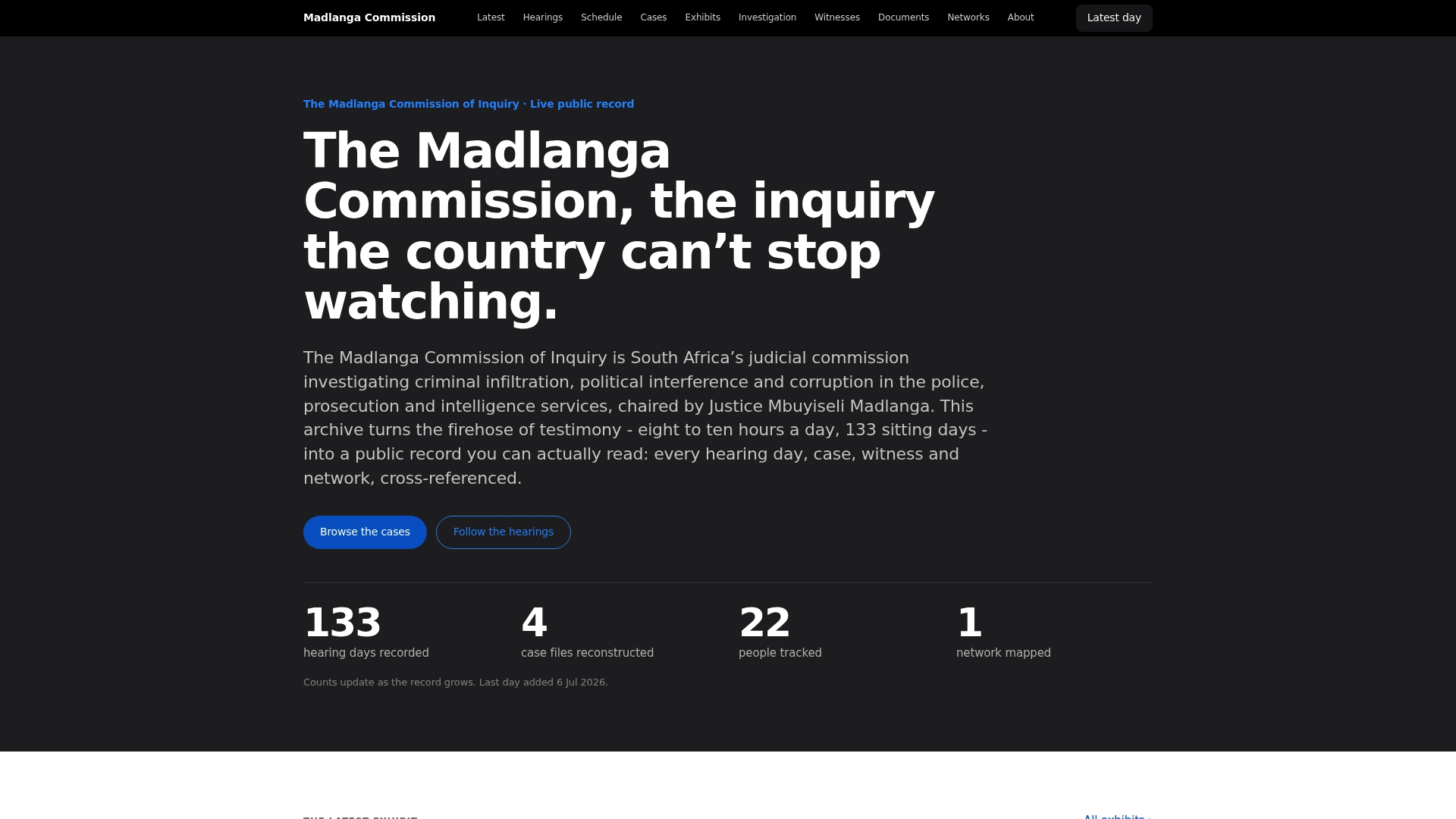
Journalists, lawyers, researchers and citizens can also go directly to witness profiles. Bheki Cele’s profile is a starting point for the police leadership questions. On the legal side, our explainer on in camera hearings shows why some evidence is not public, and selective prosecution in South Africa covers how to argue the issue with case law.
How to read infiltration claims critically
A short checklist helps whether you are a student, a reporter or just a concerned resident.
- Who said it, and in what setting? A court judgment, an ombudsman finding and a witness statement carry different weight.
- Is the language precise? “Evidence suggesting” and “substantiated on a balance of probabilities” are not convictions.
- Is there a document behind it? Messages, CCTV footage, contracts and bank records can be checked. A bare assertion cannot.
- Has the other side responded? Named individuals are entitled to reply, and the commission or court may take months to test the claim.
- Is the scope stated? A finding about the Western Cape leadership is not a finding about every station in the country.
FAQ
Has a court found that gangs infiltrated the South African police?
Yes, in part. In October 2022 the Western Cape High Court found evidence suggesting that the 28s gang had penetrated senior SAPS management in the province. That is a finding about one gang and one province, not about the entire service.
What did the Western Cape ombudsman report find?
The report, released by Premier Alan Winde in November 2025, substantiated on a balance of probabilities complaints of unacceptable behaviour by the provincial police commissioner and his senior management regarding gang links. It is an oversight finding and not a criminal conviction.
Is infiltration only a Western Cape problem?
Not according to testimony. A senior police official told the Madlanga Commission that criminal syndicates had infiltrated the police and justice system across provinces, not only Gauteng. These claims are being tested by the commission.
Who investigates police officers accused of gang links?
The Independent Police Investigative Directorate (IPID) investigates police misconduct and has confirmed a probe into gang infiltration in the Western Cape. Referrals for prosecution go to the National Prosecuting Authority.
Sources
- Western Cape Police Oversight and Community Safety statement on the Thulare judgment
- Daily Maverick: Pressure mounts on SAPS and Ipid as Winde releases ombudsman report
- Cape Argus: 28s gang trial reaches verdict stage
- Witness statement of Lt Gen Dumisani Khumalo to the Parliamentary Ad Hoc Committee
- TimesLIVE: WhatsApp leaks reveal crime gangs infiltrated SAPS and EMPD
- IOL: Khumalo links Sibiya to criminal syndicates during Madlanga Commission testimony
- Institute of Race Relations: Broken Blue Line