How to Investigate Police Corruption in South Africa

In South Africa, police corruption is investigated by more than one body, and the right route depends on who you are and what you hold. If you are a citizen with a complaint, report it to the Independent Police Investigative Directorate (IPID) or the SAPS complaints channels. If you are a journalist, researcher or lawyer, build your own picture from dockets, court records and inquiry testimony, and keep what is alleged separate from what is proven. This guide covers both routes, step by step.
TL;DR
- IPID is the body with the statutory mandate over corruption within the police. The Hawks (DPCI), IDAC and SAPS itself also have overlapping jurisdiction.
- A usable complaint names the people, the station, the dates and what happened, and comes with whatever documents you hold. Report early, because delay costs evidence.
- Strong investigations test each claim against documents, not only testimony. Direct and circumstantial evidence both count, but only if they are relevant and fit together.
- Follow the path from docket to prosecutor to court, and treat allegations as allegations until a court or commission finding says otherwise.
- The Madlanga Commission archive lets you search hearings, witnesses, rulings and exhibits in one place.
Table of Contents
- Who investigates police corruption in South Africa
- How to report suspected police corruption
- How to build and test evidence
- From allegation to court: following the case
- Allegation, finding, proof: keeping them apart
- Safeguards for people and publishers
- Perspective
- Use the Madlanga Commission record in your own work
- A practical workflow for journalists and researchers
- FAQ
- Sources
Who investigates police corruption in South Africa
South Africa spreads corruption investigation across several institutions. A Presidency-published analysis of institutional arrangements sets out the split. The Hawks (the Directorate for Priority Crime Investigation) handle priority crimes including corruption. IPID handles corruption by police. SARS covers tax-related offences, and the Financial Intelligence Centre analyses financial data. The Special Investigating Unit is different again: it runs administrative inquiries into maladministration and corruption rather than criminal investigations.
The same analysis notes that IDAC covers “high profile and complex” corruption, and that SAPS deals with general corruption. It also points out that the law does not define “serious”, “complex” or “high profile”. That is why jurisdiction overlaps, and why a single allegation can end up in more than one office.

What IPID can and cannot do
The IPID Act, 2011 allows IPID to investigate corruption matters within the police. It can start these itself, or act on a complaint from the public or a referral from the Minister, an MEC or the Secretary of Police. It may also look into systemic corruption involving the police. IPID’s own complaints procedure page repeats this mandate and states that IPID does not handle service-delivery complaints such as rudeness or failure to give feedback. Those belong with SAPS channels.
The Act gives investigators real tools. They have powers under the Criminal Procedure Act, 1977, including entry and search of premises, seizure of articles, arrests and the execution of warrants. They can also direct people to submit affidavits, appear to give evidence or produce documents.
The limits are practical. An oversight paper for the FW de Klerk Foundation describes IPID as a constitutionally intended independent civilian watchdog, created under section 206(6), but says its capacity has been limited relative to its mandate and that convictions of officers are rare. GroundUp’s reporting on how SAPS handles killings by its members found that SAPS converts fewer than one in four IPID recommendations into disciplinary convictions. Knowing this shapes how you work: a complaint is the start of a long process, so keep copies and follow up in writing.

How to report suspected police corruption
You have two main routes, and you can use both if the facts fit each.
- IPID. Use this for corruption by a police officer, especially where money, bribes, or protection of criminals is involved. Lodge it through the channels on the IPID complaints page.
- SAPS Service Complaints Centre. Per the SAPS complaints guidance, you can go to the community service centre at your local station, or to the Station, District or Cluster Commander’s office. You can also reach a Provincial Complaints Coordinator, call the National Service Complaints Call Centre on 0800 333 177, or email complaintsnodalpoint@saps.gov.za.
What a complaint should contain
SAPS lists the minimum information it expects: your full names and surname, identity number, residential or business address, telephone and cell numbers and email address. Then add a description of what happened, including the province, the police station, a case number if one exists, and details of the SAPS employees involved.
To make a complaint easier to act on, add these from your own records:
- exact dates, times and places, in the order they happened
- names, ranks, force numbers or vehicle registrations, where you know them
- amounts demanded or paid, and how (cash, EFT, voucher)
- screenshots, messages, bank statements, photos, and the names of anyone who saw it
- earlier case numbers and the names of officers who handled them
Keep originals safe and submit copies. Our guide to evidence chain of custody explains how to record who held an item and when, which protects its value later.
Report quickly
Timing matters. A Daily Maverick report on the Phala Phala policing matter showed that late formal reporting affected what investigators could still collect. Records get overwritten, witnesses forget and CCTV is deleted. A short, dated report today beats a perfect one later.
How to build and test evidence
Whether you are a complainant, a reporter or a researcher, the discipline is the same: start with the claim, then ask what would prove or disprove it.
Break the allegation into checkable facts
“Officer X is corrupt” cannot be tested. “Officer X received R5 000 on a stated date from a named person in return for releasing a vehicle” can. Write each claim as a single sentence with a who, what, when and where. Then list the evidence that would exist if it were true: a payment record, a call log, a docket entry, a release form, a witness.
Weigh direct and circumstantial evidence
Direct evidence is, for example, an eyewitness account, a confession or a payment record. Circumstantial evidence points to a fact indirectly. Fraud-investigation guidance, such as the IACRC guide to evidence, says circumstantial evidence must be relevant, cumulative, tightly organised and persuasive, by ruling out plausible innocent explanations. In practice, ask of every link in your chain: is there an innocent explanation, and does the rest of the evidence exclude it?
Cross-check testimony against documents
Testimony is the start, not the end. Compare each witness account with the record: dates against occurrence books and dockets, payments against bank data, meetings against phone and location records. Where a witness contradicts a document, note it and do not resolve it in your own favour. Our explainer on commission evidence rules in South Africa shows how commissions admit and weigh material that a criminal court might treat differently.
Protect the chain
Evidence that cannot be shown to be untouched is easy to attack. Record where each item came from, who held it and how it was stored. The chain of custody guide lists what a custody form should capture.
From allegation to court: following the case
Most people lose the thread after the complaint. The path in a criminal matter is predictable, and the SANEF guide to reporting the courts lays it out.
| Stage | What happens | What to look for |
|---|---|---|
| Complaint | A case or complaint number is recorded | Keep the reference and the officer’s name |
| Docket | Police open a docket and investigate | Ask in writing for status updates |
| Referral | When investigators believe the evidence is enough, the docket goes to the National Prosecuting Authority | The prosecutor decides whether to prosecute |
| Decline | If the evidence is not strong enough, the NPA may decline | Ask for the reasons and whether a review is possible |
| Court | The accused must be brought before court within 48 hours of arrest, excluding non-court days | Court roll, charge sheet, bail outcome |
| Trial | The State leads evidence and calls witnesses, followed by cross-examination | Transcripts, exhibits, judgment |
IPID also reports on its high-profile cases to Parliament. A Parliamentary Monitoring Group record shows IPID presenting such cases to SCOPA under section 28 of the IPID Act, which is a useful place to look for the status of cases that attract public attention.
When a docket stalls, look for a reason in the record: missing evidence, a reassigned officer, a referral between agencies. Overlapping mandates mean cases sometimes sit in the gaps.
Allegation, finding, proof: keeping them apart
The Phala Phala policing matter is a good lesson. According to the Daily Maverick report, SAPS said there was not enough evidence for disciplinary outcomes, and said that did not mean the matter was not serious. IPID, for its part, had found mishandling and recommended disciplinary action on information of evidential value. Two bodies, one set of facts, different conclusions about sufficiency.
When you write or research, use this ladder:
- Alleged: someone says it happened.
- Investigated: a body has looked into it and may have made recommendations.
- Charged: the prosecution has decided there is a case.
- Found or convicted: a court or commission has made a finding on the evidence.
Only the last rung supports a flat statement of guilt. Name the source of every claim and its status.
Safeguards for people and publishers
The law protects people who are questioned. Under the IPID Act, a person questioned by an investigator must answer truthfully to the best of their ability, but need not answer if the answer would incriminate them, and the investigator must tell them of that right. A self-incriminating answer given to an IPID investigator is not admissible against that person in later criminal proceedings, except in proceedings for perjury. If you are asked to give a statement and are worried about your own exposure, speak to an attorney before you do.
If you publish, the standard is accuracy and fair attribution. In a Press Council ruling, Gama v Sunday Times, the complaint was dismissed because the newspaper’s sources and attribution were convincing and there was no proof that it had misstated the allegations. Attribute to documents and named sources, give the person concerned a fair chance to respond, and describe exactly what a document says rather than what you infer.
Perspective
Most people who try to investigate police corruption do not fail for lack of interest. They fail because the record is scattered. A hearing day sits in one place, a witness statement in another, a ruling in a third, and by the time you have pieced them together the story has moved on.
This is the problem we set out to solve. The Madlanga Commission is examining criminal infiltration, political interference and corruption in the police, prosecution and intelligence sectors. Our archive turns that long, complex record into something you can search and cross-reference: cases, witnesses, exhibits, rulings and official documents, tied together, without having to follow every live proceeding.
We believe that is what makes a public inquiry useful beyond the hearing room. A citizen can check what was said. A journalist can trace a claim to its source. A researcher can compare patterns across cases. A lawyer can see how the evidence was put and ruled on. Transparency only works when people can actually use it.
Meriol Lainchyon
Use the Madlanga Commission record in your own work
The Commission’s evidence is one of the richest public records of alleged police corruption in South Africa. Our archive organises daily hearing records, case files, witness profiles, exhibits, rulings, statements and media briefings so that you can follow an allegation from first mention to later testimony.
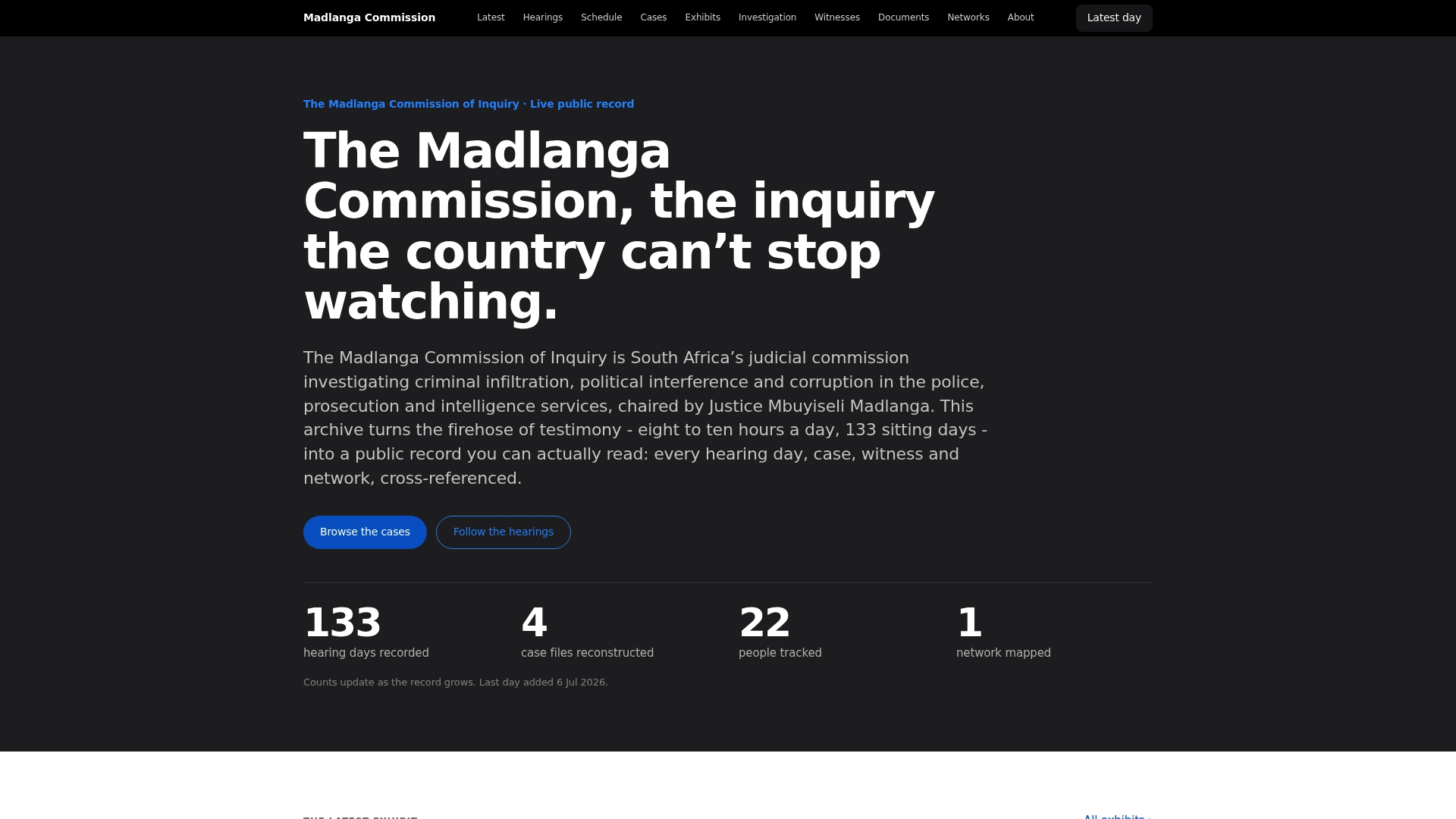
Start with the case files to see how matters are grouped, then open witness pages such as Mohammed Sayed, Jotham Msibi or Ignatius Mothakathi to follow individual testimony. Our articles explain the legal ideas behind the record, including selective prosecution. The Commission’s own site also publishes live hearings, transcripts, statements and rulings, including downloadable PDFs, which is the primary source to cite.
A practical workflow for journalists and researchers
- Define the question. One allegation, one person or one unit at a time.
- Collect primary sources. Transcripts, rulings, statements, exhibits, court rolls, IPID and SAPS replies.
- Build a timeline. Put every event, document and testimony on a dated line, with its source beside it.
- Mark each item. Allegation, document, finding or conviction.
- Test the weak links. Where only one witness supports a claim, look for a document, and where a document exists, look for who created it.
- Seek a response. Give those implicated a fair chance to answer, in writing, with a deadline that is reasonable.
- Keep a record. Save dated copies of pages and files so you can show what you relied on.
For jurisdiction questions, use the table of bodies above. If an allegation involves a police officer taking bribes, IPID is the natural home. If it concerns organised crime or a politically connected network, the Hawks or IDAC may be involved, and the overlap is exactly what you should document.
FAQ
Where can I report police corruption in South Africa?
Report it to IPID, which investigates corruption within the police, or to SAPS through the Service Complaints Centre on 0800 333 177. You can also visit the community service centre at your local station or the Station Commander’s office. Give names, dates, places and any documents you hold.
Does IPID investigate every complaint against the police?
No. IPID must investigate specified matters such as deaths in custody and rape by police, and it may investigate corruption within the police. It does not handle service-delivery complaints such as rudeness or failure to give feedback, which go through SAPS channels.
Who investigates if the corruption is bigger than one officer?
IPID may investigate systemic corruption involving the police. The Hawks cover priority crimes and IDAC covers high-profile and complex corruption, and their jurisdictions overlap because the law does not define those terms. Say in your complaint if you believe a network is involved.
Can I be forced to answer an investigator’s questions?
Under the IPID Act you must answer truthfully, but you need not answer if the answer would incriminate you, and the investigator must tell you so. A self-incriminating answer cannot be used against you later, except in a perjury case. Speak to an attorney if you are unsure.
How can I follow a police corruption case after it is reported?
Keep your case number and ask for written updates. Check whether the docket went to the NPA, then look at court rolls and judgments. For matters before the Madlanga Commission, search our archive for hearing records, witnesses and rulings.
Sources
- Independent Police Investigative Directorate Act, 2011
- Institutional arrangements for corruption investigation, Presidency appendix
- IPID complaints procedure
- SAPS Service Complaints Centre
- Integrity and Oversight in South Africa’s Law Enforcement, FW de Klerk Foundation
- How SAPS protects the killers within its ranks, GroundUp
- SAPS says not enough evidence against Phala Phala cops, Daily Maverick
- What fraud investigators should know about evidence, IACRC
- Reporting the Courts, SANEF guide
- IPID investigations of high profile cases, PMG
- Thobekile Emelda Gama v Sunday Times, Press Council
- Judicial Commission of Inquiry into Criminality, official site