Perjury in Inquiries: What South African Law Says

A witness who lies under oath at a South African commission of inquiry can be prosecuted. The offence sits in section 6(2) of the Commissions Act, 1947, and it applies once a witness has been sworn or has affirmed. It also covers a witness who gives evidence they do not know or believe to be true. Common-law perjury and a separate statutory offence for false affidavits sit alongside it. This article explains how the three fit together, what the State must prove, what penalties apply and how a suspected lie at an inquiry becomes a criminal case.
TL;DR
- Giving false evidence before a commission, after an oath or affirmation, is an offence under section 6 of the Commissions Act, 1947.
- The offence reaches a witness who knew the evidence was false and one who did not know or believe it to be true.
- An honest mistake is not perjury, but a lie need not be material or cause prejudice for a charge to stand.
- A commission cannot prosecute anyone itself. Its findings may be referred to the National Director of Public Prosecutions (NDPP), who decides.
- The Commissions Act penalty is a fine of up to one hundred pounds, up to twelve months’ imprisonment, or both.
Table of Contents
- What perjury means in South African law
- Why inquiries have their own perjury provision
- The Commissions Act offence in section 6(2)
- What prosecutors must prove
- Statutory perjury: false affidavits
- How a suspected lie becomes a prosecution
- Penalties
- What the courts say about lying under oath
- Practical guidance for witnesses
- How to spot contradictions as a reader
- Perspective
- Follow the record yourself
- FAQ
- Sources
What perjury means in South African law
The South African Police Service describes common-law perjury as the unlawful and intentional making of a false statement in a judicial proceeding, by a person who has taken an oath or made an affirmation, or who was admonished, before someone competent to administer or accept it.
Each part of that description does work:
- Unlawful and intentional. The person must know the statement is false and mean to make it. Carelessness alone is not enough.
- A statement. It can be spoken evidence or a written one, such as a sworn document.
- Oath, affirmation or admonition. An oath is a sworn promise, an affirmation is the non-religious equivalent, and an admonition is a formal warning to speak the truth, often used for young or vulnerable witnesses.
- A competent person. The one administering the oath must have the authority to do so.
The point of the offence is to protect the integrity of proceedings. Legal commentary describes it as a serious crime because it corrupts the administration of justice. A decision-maker who cannot rely on sworn evidence cannot do the job.
Why inquiries have their own perjury provision
A commission of inquiry is not a court. The SANEF guide for court reporters explains that commissions are inquisitorial rather than adversarial, and are not strictly bound by the rules of evidence that apply in formal court proceedings. The same guide notes that commissions can compel witnesses, using powers comparable to those of a High Court, but they seek the truth and do not try accused persons.
Academic commentary says the same thing from the fairness side: a commission is not a court of law, and its duty to act fairly is flexible and does not import court rules of evidence.
That creates a gap. Common-law perjury speaks of a “judicial proceeding”. A commission has no accused, no verdict and looser evidence rules. Parliament closed the gap with a dedicated offence in the Commissions Act. If you want the wider picture of how evidence is received at inquiries, our guide to commission evidence rules in South Africa covers it.
The Commissions Act offence in section 6(2)
Under section 6(2) of the Commissions Act, a person commits an offence if, after being sworn or having made an affirmation, they give false evidence before a commission on any matter, knowing it to be false or not knowing or believing it to be true.
The wording has three practical consequences.
It applies after the oath or affirmation
The trigger is the oath or affirmation. Casual remarks made outside the hearing, in the corridor or to the media, are not covered by this provision. A statement made to a commission’s investigators is a different matter and depends on whether it was made under oath, for example in a sworn affidavit.
It covers more than a deliberate lie
The first limb is the classic case: the witness knows the evidence is false. The second limb is wider. It catches evidence the witness does not know or believe to be true. A witness who asserts something as fact, with no basis for believing it, is within its reach. This is why careful witnesses separate what they saw, what they were told and what they assume, and say which is which.
It applies to any matter
The provision speaks of false evidence “on any matter”. Nothing in the text limits it to the central question the commission is investigating. For a witness, this means small details deserve the same care as the headline allegations.
What prosecutors must prove
For common-law perjury, the State must prove a false statement, made in a judicial proceeding, under oath, affirmation or admonition, unlawfully and knowingly. Legal commentary notes that mistakes made without intent to lie are not perjury, and that the State does not need to prove the false evidence was material to an issue or caused prejudice to anyone.

In practice, the usual battleground is the witness’s state of mind. Prosecutors typically try to show it through the record: earlier statements, documents the witness signed, messages, or other sworn evidence that contradicts the testimony. A contradiction alone does not prove a lie. Memory fails, especially over long periods and traumatic events, and a witness may correct themselves. What matters is whether the person knew the statement was untrue when making it.
A mistake is not a lie
Honest error, confusion about dates and a good-faith belief later shown to be wrong are not perjury. This protects witnesses who testify about events years in the past. It also explains why a witness who corrects a mistake promptly and openly is in a very different position from one who doubles down.
Statutory perjury: false affidavits
Many inquiry witnesses first give their evidence in writing, in a sworn statement, before they ever speak at a hearing. Here a second offence matters. Section 9 of the Justice of the Peace and Commissioners of Oaths Act, as quoted in Malinga v Minister of Police (Gauteng High Court, 22 July 2021), makes it an offence to make a false statement in an affidavit or a solemn or attested declaration before a competent official, knowing it to be false. It carries the penalties prescribed for perjury.
It is popularly called “statutory perjury”, but the courts are careful about the label. In S v Ncamane (Free State High Court, 28 November 2019), the court treated the section 9 offence as an independent offence, so common-law perjury rules such as corroboration do not apply to it.
For anyone preparing a statement for an inquiry, the lesson is simple: a signed and commissioned affidavit is evidence in its own right, with its own criminal exposure, before any hearing takes place.

How a suspected lie becomes a prosecution
A commission makes findings and recommendations. It does not charge, try or sentence anyone. If a chairperson believes a witness has lied, the route to a prosecution runs through the prosecuting authority.
The Bathabile Dlamini matter shows the path. After the inquiry into the social grants crisis, the Constitutional Court ordered the inquiry’s report to be forwarded to the NDPP to consider prosecution. The Gauteng Director of Public Prosecutions decided to prosecute, and a summons was issued for her to appear in the Johannesburg Regional Court.
The sequence is worth noting:
- The inquiry hears evidence and records it.
- The inquiry’s findings, or a court order, send the matter to the NDPP.
- The prosecuting authority reviews the record and decides whether to charge.
- If it charges, the case runs in an ordinary criminal court, where the accused has full trial rights and the State carries the burden of proof.
The commission’s findings are not a conviction. They are a basis on which prosecutors may act, and the criminal court decides afresh.
Penalties
The Commissions Act sets the penalty for false evidence at a fine not exceeding one hundred pounds, imprisonment for up to twelve months, or both. The figure is in pounds because the statute dates from 1947 and the text still reads that way. Anyone relying on penalty figures should check the current text of the Act and any later amendments before drawing conclusions.
The penalty should not be read as the full consequence. A finding that a witness was untruthful can damage credibility in every other proceeding, end a career in a regulated profession and shape how a commission weighs everything else that person said.
What the courts say about lying under oath
South African courts take false evidence seriously. A North Gauteng High Court judgment in Pretoria records that perjury and fraud are treated as serious criminal charges, which can lead to dismissal for officers of the court and to prosecution for individuals who give false evidence under oath.
The same judgment, which reviewed a decision to decline prosecution of an official, also illustrates how an affidavit can found a perjury charge: lying under oath in an affidavit is a basis for a charge if the person did not have the information they claimed to possess. The principle is that you may not swear to knowledge you do not have.
Practical guidance for witnesses
This is general information, not legal advice. A witness who is worried about their own exposure should consult an attorney or advocate before giving a statement, and before answering questions that touch on their own conduct.
Careful witnesses tend to do the following:
- Separate knowledge from belief. Say “I saw”, “I was told” and “I assume” as distinct things.
- Say “I do not remember” when that is true. Guessing to fill a gap is the riskiest option, given the second limb of section 6(2).
- Read every affidavit line by line before signing. The offence for false affidavits applies to what is signed, whoever drafted it.
- Correct errors quickly. An open correction is evidence of good faith.
- Check documents before testifying. Dates, names and amounts are where contradictions usually arise.
Our article on what witnesses must know about evidence in inquiries goes deeper on preparation, and the page on contempt of inquiry covers the separate conduct that can also attract sanction.
How to spot contradictions as a reader
Journalists, researchers and citizens often ask how to tell whether testimony is truthful. A single reading cannot answer that, and only a court can decide perjury. What a careful reader can do is build a record:
- Track what each witness said, and when. Compare oral evidence to earlier written statements.
- Match claims to exhibits. Documents either support a statement or they do not. See our guide to exhibits in inquiries.
- Note corrections. A witness who revises evidence is not necessarily lying, and the revision itself belongs in the record.
- Stay within the terms of reference. What the commission was asked to examine shapes what counts as relevant, as explained in our terms of reference guide.
- Report allegations as allegations. A contradiction is not a conviction, and a commission finding is not a court verdict.
This discipline protects readers as well as witnesses. Saying a person “committed perjury” before a court has found so is a legal risk for the one who says it.
Perspective
Perjury allegations are easy to make and hard to follow. A witness gives a written statement months before a hearing, adds to it in the box, is questioned on documents introduced days or weeks apart, and sometimes returns to correct the record. The truth about whether someone lied usually lives in the gaps between those moments, and nobody can see the gaps if they only watch a clip or read a headline.
That is why we built the archive around cross-referencing. When a witness profile links to the daily hearing record, the exhibits and the official documents, a reader can check a claim against what was actually said and produced, instead of relying on someone’s summary. We think this is what public accountability needs: not a verdict from the public gallery, but a record anyone can search and test for themselves.
We do not decide who is telling the truth. The law gives that job to the prosecuting authority and the courts. Our job is to make the record clear enough that those decisions can be understood, questioned and followed.
Meriol Lainchyon
Follow the record yourself
If you are tracking testimony at the Madlanga Commission, our archive brings hearing records, witness profiles, exhibits, rulings and statements together in one searchable place, so you can follow developments without watching the live proceedings.
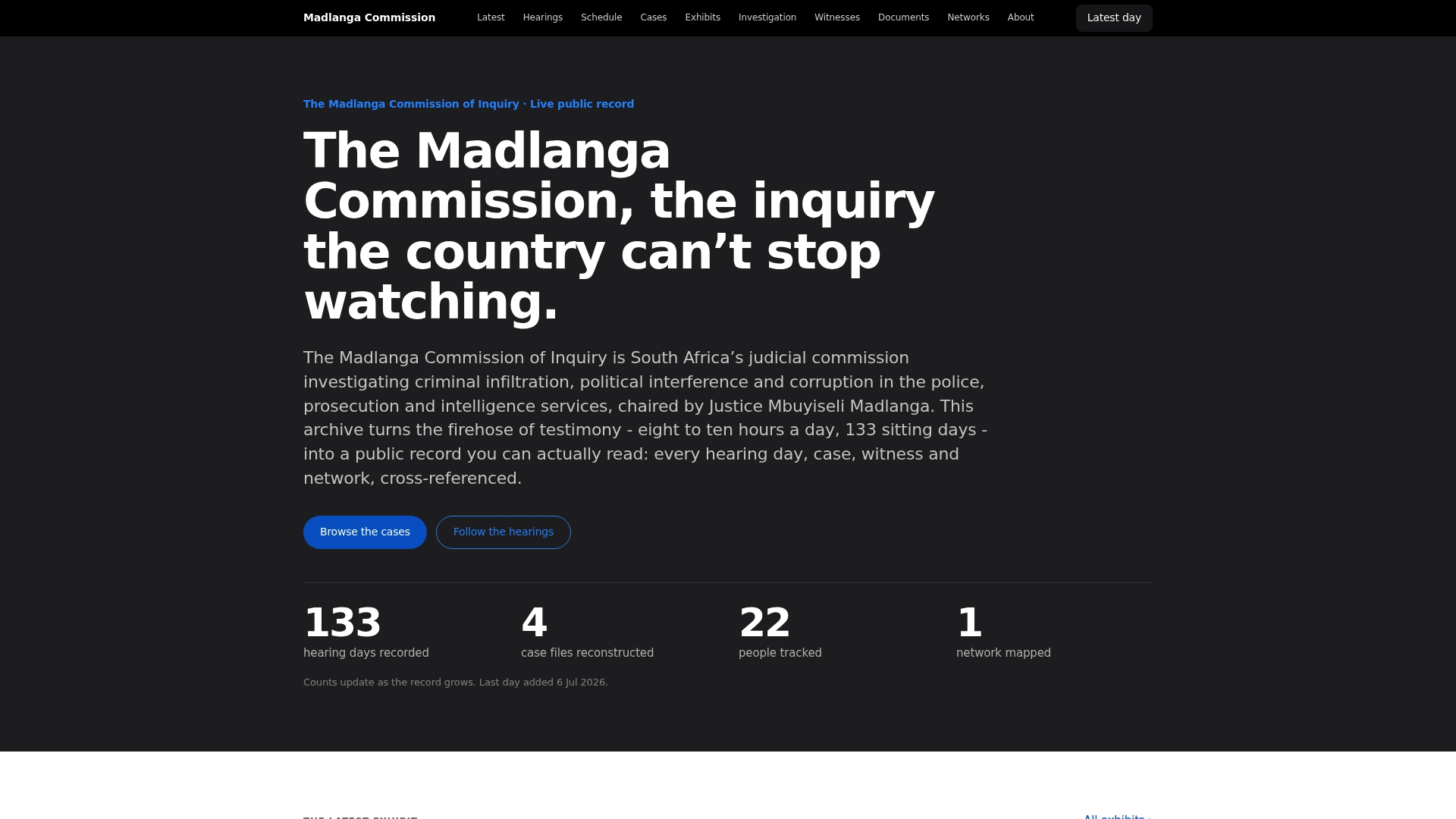
Start from a witness profile, such as Dr Ntandazo Sifolo, Dr Bejani Chauke or Warrant Officer Johannes Mokgatle, then move to the linked records. For a wider view, browse the Madlanga Commission archive or read how to find Madlanga records among South Africa’s judicial commissions. Our method for building a witness picture is set out in research witness profiles.
FAQ
Can a witness at a commission of inquiry be charged with perjury?
Yes. Section 6(2) of the Commissions Act makes it an offence to give false evidence before a commission after being sworn or affirming, knowing it to be false or not knowing or believing it to be true. The commission itself does not prosecute. That decision rests with the prosecuting authority.
Is a mistake in testimony perjury?
No. Perjury requires that the statement was made unlawfully and knowingly. Legal commentary on South African law confirms that mistakes made without intent to lie are not perjury. The Commissions Act also reaches evidence a witness did not believe to be true, so witnesses should say when they are unsure.
What is the penalty for lying at an inquiry?
Under the Commissions Act, 1947, a person convicted is liable to a fine of up to one hundred pounds, imprisonment of up to twelve months, or both. Check the current text of the Act before relying on it. A finding of untruthfulness can also harm a witness’s credibility and career.
Is lying in an affidavit the same as perjury?
Not exactly. Section 9 of the Justice of the Peace and Commissioners of Oaths Act creates a separate offence for knowingly false statements in affidavits and declarations, often called statutory perjury. The Free State High Court has held that it is an independent offence, so common-law perjury rules such as corroboration do not apply to it.
Who decides whether to prosecute a witness after an inquiry?
The National Prosecuting Authority decides. In the Bathabile Dlamini matter, the Constitutional Court ordered the inquiry report to be sent to the NDPP, the Gauteng DPP decided to prosecute, and a summons was issued for the Johannesburg Regional Court.
Sources
- South African Police Service: what is perjury
- Commissions Act, 1947, section 6: offences by witnesses
- SANEF: Reporting the Courts, commissions of inquiry
- Runeli v Minister of Home Affairs and others (Obiter)
- The Legal Desk: what is perjury?
- Malinga v Minister of Police, Gauteng High Court, 2021
- S v Ncamane, Free State High Court, 2019
- The Citizen: Dlamini to be prosecuted for giving false evidence
- North Gauteng High Court, Pretoria, 2017 judgment