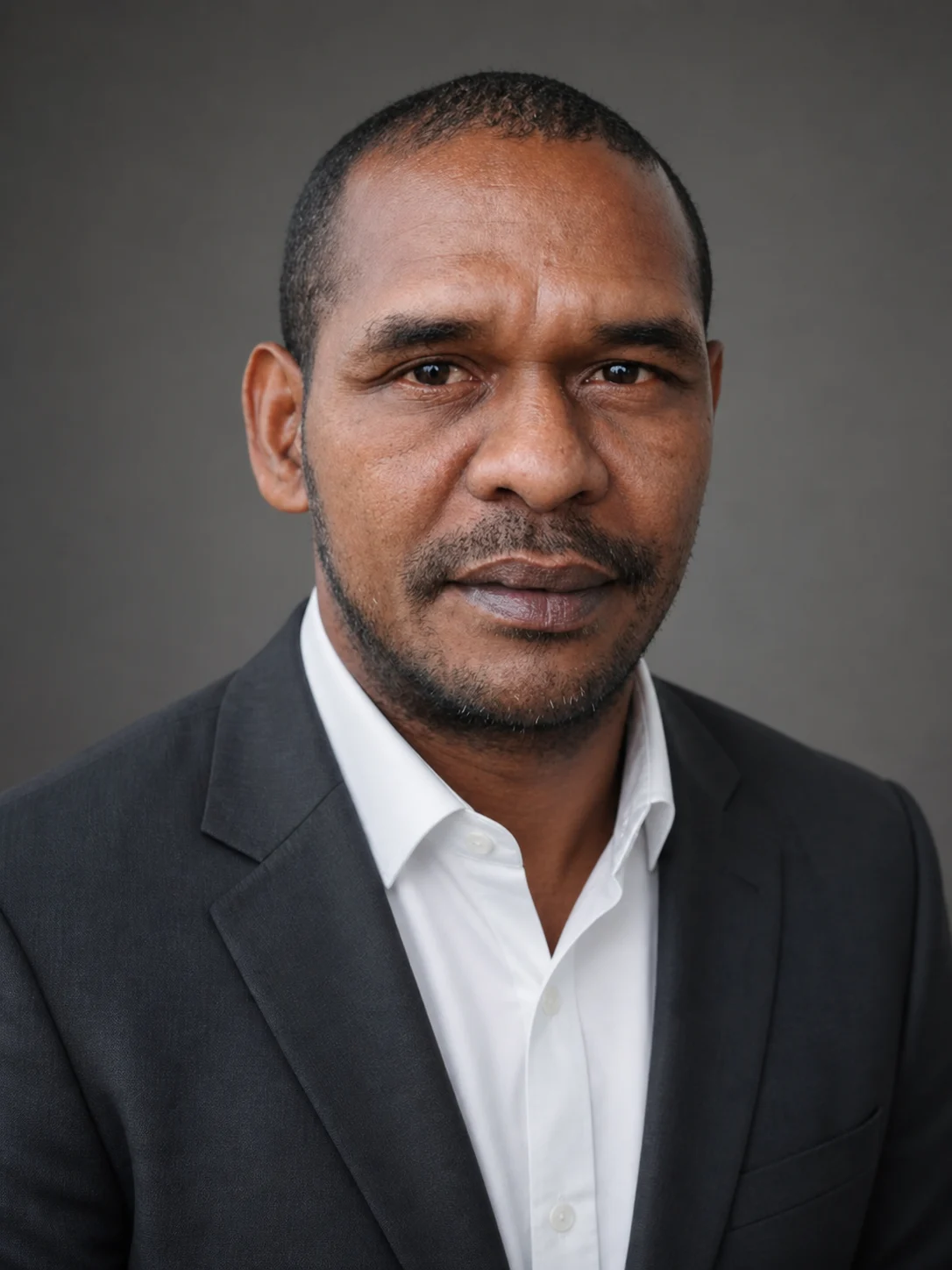
His section 27 referral founded the Crime Intelligence investigation
Adams's complaint to IDAC, a section 27 referral, asked for an investigation into the Political Killings Task Team over allegations that its members had misused the police's secret service slush fund. It is the document from which the entire prosecution of Lieutenant-General Dumisani Khumalo and his co-accused flows. The NPA provisionally withdrew those charges on 27 July 2026, before plea, on the express basis that the investigation was incomplete.
The paperwork attributed to him is disputed from several directions
Colonel Brian Padayachee conceded on Day 141 that he did not have Adams's original signed affidavit when the investigation commenced, which chairperson Mbuyiseli Madlanga called 'highly improbable'. On Day 148 two IDAC officials - Advocate Drushantha Ramsamy and investigator Mantsha Robert Raphesu - disputed on recorded voice notes the authenticity of a supplementary statement marked 'A1' attributed to Adams and filed by chief investigator Dylan Perumal. On Day 152 Raphesu alleged that then IDAC head Advocate Andrea Johnson had put a false version of the referral before Parliament's ad hoc committee. On Day 153 Advocate Peter Serunye said he was repeatedly refused the referral itself. None of this is an allegation that Adams did anything wrong with the document; it is a dispute about what IDAC did with it. All of it is untested.
Parliament disputes his account of a ten-month delay
On 11 August 2026 Adams attributed a ten-month delay in submitting his statement to the commission to a parliamentary laptop that persistently froze and had to be returned for repairs repeatedly. Chairperson Mbuyiseli Madlanga called the explanation 'unbelievable', and the delay forced his public testimony to be postponed so the commission could review the statement. Parliament issued a statement that evening saying its ICT service desk records 'do not reflect any reported incident of persistent laptop malfunction, hardware failure, repeated freezing of the device, or the laptop being repeatedly submitted to ICT for repairs', with only routine user-access and account-support matters logged.
Says he will 'drop big bombs' when he testifies
Adams told eNCA in August 2026 that he would 'expect bombs, big ones' when he eventually gives evidence before the commission, and called on IDAC state advocate Drushantha Ramsamy to release a recording of him running to almost two hours which he says she holds. As at his first day of evidence on 19 August 2026 that account had not been given: the sitting was taken up with the correspondence and his credibility.
Admitted on Day 162 that his evidence about the correspondence was wrong
On 19 August 2026 chairperson Justice Mbuyiseli Madlanga put to Adams the commission's Rule 3 notice, sent through its attorney on 3 October 2025, asking him to answer allegations Lieutenant-General Nhlanhla Mkhwanazi had made against him - against Adams's evidence that he had only seen the request some three months earlier. The record showed he replied on 14 October 2025, eleven days later, and asked to testify; his statement was only filed on 10 August 2026. 'The information I submitted was wrong,' he told the commission. 'I did forget about this email.' He rejected the suggestion that he had set out to mislead the inquiry, saying 'I could have done better and should have done better' and 'I take the Madlanga Commission seriously'. The commission also played back media interviews in which he denied receiving any correspondence while claiming he had approached the inquiry himself. The commission has made no finding on his credibility.
Mkhwanazi alleges he had Crime Intelligence information he was not entitled to
The allegation Adams was called to answer originates with KwaZulu-Natal commissioner Lieutenant-General Nhlanhla Mkhwanazi, who told the commission in September 2025 that Adams had obtained access to Crime Intelligence information he was not entitled to and had used it recklessly in pursuing charges against members of the Political Killings Task Team. Lieutenant-General Dumisani Khumalo has separately said Adams's objections amounted to personal opinion rather than evidence. Adams had not answered the substance of that allegation on the record as at 19 August 2026. Untested; he is presumed innocent.
Suspended from Parliament for 20 days in an unrelated ethics matter
On 5 August 2026 Parliament suspended Adams for 20 days, from 3 to 28 August 2026, and docked his pay, after the Joint Committee on Ethics and Members' Interests found he had breached the Code of Ethical Conduct by publishing a Facebook post containing the personal contact details of a Democratic Alliance staff member. The committee treated it as an aggravating factor that this was his second social-media breach of the Code. The suspension has nothing to do with the Madlanga Commission, but it means the man giving evidence about a Crime Intelligence prosecution was doing so while barred from the House.
Day 163: named a dead general as the source of 90 percent of it
On 20 August 2026 Adams told the commission that about 90 percent of what he alleged about Crime Intelligence vetting and appointments came from the late Major-General Andre Lincoln, who died on 30 May 2025. He had not named Lincoln to Western Cape provincial commissioner Lieutenant-General Thembisile Patekile, to the Inspector-General of Intelligence, to the police minister or to IDAC, and gave the name for the first time to Parliament's ad hoc committee after Lincoln's death. His explanation was that Lincoln was fighting for an unpaid pension and that naming him would have harmed him. Asked directly, he said: 'I wouldn't have mentioned him if he was alive.' Evidence leader Advocate Lee Segeels-Ncube responded: 'No, Mr Adams, you have the CAS numbers now. You cannot rely on a dead man every time. It is unacceptable.' Put to him that Lincoln was either mistaken, misinforming him, or had never said it, Adams answered: 'I'm going to grudgingly accept that my friend may have been wrong.' Untested; no finding has been made.
Day 163: conceded that what he told the minister about Gauteng was wrong
The Orlando SAPS docket Adams opened on 31 October 2024 carries a 13:30 stamp. At 08:21 the next morning an email sent through NCC MP Sakiena Frenchman's address, but typed by Adams, told suspended Police Minister Senzo Mchunu that Gauteng police had 'followed the same modus operandi as the Western Cape' and were interfering in the investigative process. On his own evidence the only thing that had happened in between was a call from Lincoln saying they were about to try again. Adams conceded: 'I will concede that I could have worded it better,' and said it was not a deliberate attempt to mislead the minister. Commissioner Sesi Baloyi told him the sequence 'stinks of machinations'. The email reached Mchunu's chief of staff Cedrick Nkabinde at 08:25 and by 09:04 he had instructed a major-general to report back by 15:00 on Monday 4 November 2024. Untested; all named are presumed innocent.
Day 163: accepted that the dockets in Pretoria were not intercepted
Commissioner Sandile Khumalo took Adams through the inspectorate paper trail showing that his six dockets reached national office because his own 1 November 2024 complaint to the minister generated a service complaint that Lieutenant-General Peter Jacobs's division had 48 hours to report on. Colonel Phillips, the section commander for complaints collation, called for the dockets to assess them, recorded on 20 November 2024 that the affidavits were 'superficial' and 'believed to be hearsay', and made four documented attempts to interview Adams. Adams admitted he gave Phillips the runaround because he believed it was a cover-up, and that the advice not to meet him came from Lincoln: 'don't meet with this guy.' He accepted the correction twice, the second time saying: 'I understand and I accept that I'm the one that muddied the water.' Chairperson Justice Mbuyiseli Madlanga twice told him he was not being truthful about not connecting Phillips's call to his own complaint. No finding has been made.
Day 163: the man who let him into Orlando SAPS is Witness G
Adams described flying into OR Tambo on 31 October 2024, receiving from Lincoln the WhatsApp contact of a man he knew only as 'Elvis', and being met and taken into Orlando SAPS by him. Shown the statement of Witness G - the Crime Intelligence official who testified in camera in May 2026 and who is described in evidence as Brown Mogotsi's handler - Adams said: 'This is the man that I described as Elvis.' He disputed the sequence in Witness G's account, denied knowing him, denied any relationship with suspended Crime Intelligence deputy head Major-General Feroz Khan, and said he saw the man once and never again. A commissioner put to him that 'almost every case that is opened in Soweto relating to our terms of reference somehow has Mr Mogotsi's fingerprints'. Adams denied Mogotsi had any hand in it, saying he spoke to Mogotsi once by phone, at Lincoln's house, about Lincoln's unpaid pension. Nothing improper has been established about the contact; all named are presumed innocent.
Has laid a criminal case against IDAC and IDAC officials
During his Day 163 evidence Adams told the commission he had laid a criminal case against IDAC and IDAC officials and asked to be guided on what he could say about matters under investigation. The evidence leader asked him to provide the case details so the commission can deal with any objection he raises on that basis; he agreed to hand them over. On Day 164 he went further, telling the commission he intends to lay criminal charges against IDAC state advocate Drushantha Ramsamy personally and to report her to the Legal Practice Council. The case is separate from, and runs in the opposite direction to, the prosecution his own section 27 referral founded. Untested on both sides; everyone concerned is presumed innocent.
Day 164: accepted that he had probably been used
Asked at the close of his evidence whether he had been used by IDAC to pursue a case against senior Crime Intelligence officials, Adams said: 'I do believe I was used.' He said the withdrawal of the charges had made him question aspects of the case while maintaining that the material he received appeared genuine and that he gained nothing from it - 'there was nothing in it for me. This has cost me big time' - and that his record of activism against gangs and drugs on the Cape Flats made him an obvious recipient for an anonymous disclosure: 'somebody probably put his money on, now this guy will lay a charge.' He said he would do the same again. The chairperson's own characterisation of the three days, as the SABC reported it, was that the evidence suggests Adams was either used or a willing participant in wrongdoing. Both remain open; neither is a finding.
Day 164: the IDAC recording contradicted his Orlando evidence
Adams asked the commission not to play the recording state advocate Drushantha Ramsamy made of their 6 January 2025 consultation, and told it he would lay criminal charges against her and report her to the Legal Practice Council. Parts were played. On the recording he told IDAC that he had no connections at Orlando police station - the opposite of the evidence he has now given, that he was met at Orlando and taken inside by the man he knew as 'Elvis', whom he has accepted is Witness G, the Crime Intelligence colonel described in evidence as Brown Mogotsi's handler. Commissioner Sesi Baloyi put it to him that the change was deliberate: 'You changed it today because you were confronted with the facts. That is not oversight; it's a deliberate decision.' Adams did not accept that characterisation. Untested; he is presumed innocent.
Day 164: two sworn accounts of the call from the Inspector-General's office
Commissioner Baloyi confronted Adams with a contradiction between two statutory forums: he told Parliament's ad hoc committee that suspended Inspector-General of Intelligence Imtiaz Fazel had personally contacted him about his Crime Intelligence complaint, and told this commission that the call came from a member of Fazel's staff. 'One of these two institutions must hold you to have lied under oath. You accept that?' she asked, adding: 'How could you possibly mistake a call from such an important person?' Adams said the parliamentary version was the mistaken one - 'I made a mistake in front of the ad hoc committee, and I'm here admitting to the mistake and owning up to it' - and described it as a genuine, stupid, sloppy mistake. Untested; he is presumed innocent.
Day 164: conceded he was not truthful about first contact with Nkabinde
Adams had placed his first contact with Cedrick Nkabinde, chief of staff to Police Minister Senzo Mchunu, on 1 November 2024 - the morning after he laid the Orlando charges. Evidence leader Advocate Lee Segeels-Ncube produced an email trail showing communication before that date, and Adams accepted that the version he had given was false. The concession matters because the innocence of the 43-minute ministerial escalation on 1 November depends on the complainant and the ministry not having been in contact beforehand. Untested; both men are presumed innocent.
Day 164: did not know the name of the brigadier his complaint helped charge
Adams told the commission that when he laid the charges that founded the Crime Intelligence prosecution he did not know Brigadier Dineo Mokwele's name; he knew her as 'the BMW lady'. Mokwele's appointment as head of Crime Intelligence's Technical Support Services was the transaction on which the whole fraud and corruption case rested. She was arrested in June 2025 and the charges against her were withdrawn unconditionally on the morning of this hearing.
Day 164: maintains the section 27 referral before the commission was altered
On the one point he did not concede, Adams insisted that the section 27 affidavit IDAC produced as his is not the document he signed, because it omits the allegations he says he made about the Political Killings Task Team and about irregularities involving a forklift: 'someone has altered this thing. I don't know why; I don't know how.' Commissioner Sandile Khumalo pressed him for an explanation the commission could work with and did not get one. It is the same thread as Colonel Brian Padayachee's Day 141 concession that he never had the original signed affidavit, and Advocate Peter Serunye's Day 153 evidence that he was refused the referral entirely. Untested; everyone concerned is presumed innocent.