Commission Exhibits in South Africa: How to Read and Cite Them

An exhibit in a South African commission of inquiry is a document, recording, photograph or object formally placed before the commission and added to its record. It is different from testimony, which is what a witness says aloud. A good citation points to both: the witness and the exhibit number the witness was speaking to. This guide explains what exhibits are, how the numbering works in practice, how to cite one, and what can limit public access.
TL;DR
- An exhibit is evidence the commission has formally received: a document, affidavit, video, recording or object. Testimony is spoken evidence, often given while referring to an exhibit.
- Commissions are not bound by strict court rules of evidence, so material can be received that a court might refuse. Receiving an exhibit is not the same as the commission accepting it as true.
- Exhibit numbers are labels that belong to one commission’s record. Always cite the commission, the bundle or bookmark, the exhibit number and the hearing day together.
- Confidentiality claims are made in writing and ruled on by the chairperson, so some material may be redacted or withheld.
- On our archive you can follow exhibits from the witness or the case, without watching hours of live feed.
Table of Contents
- What an exhibit is, and what it is not
- Why commissions treat exhibits differently from a court
- How exhibit numbering works in practice
- How to cite a commission exhibit
- Reading an exhibit alongside testimony
- Can the public see commission exhibits?
- Perspective
- Follow the Madlanga exhibits in one place
- Common mistakes when working with exhibits
- FAQ
- Sources
What an exhibit is, and what it is not
In everyday talk people say “the evidence” for everything a commission hears. In a record, the word covers two different things.
Testimony is what a witness says under oath or affirmation. It lives in the transcript and the video of the hearing day.
An exhibit is a document or item the commission has received and given a reference. Examples include a bank statement, an affidavit, a cellphone extraction report, a photograph of seized cash, a vetting file or a recording.
The formal rules of one recent judicial commission describe the category broadly. Evidence includes documents, affidavits, videos, recordings and oral testimony submitted to the Commission. So a video can be both evidence and an exhibit, while the words a witness speaks about it are testimony.
In practice, a witness is often handed a document, asked to identify it, and then asked questions about it. Once identified and accepted, the document takes an exhibit reference. After that, anyone can refer to “Exhibit X” and everyone knows which page, photo or file is meant.
Why commissions treat exhibits differently from a court
A commission of inquiry is not a trial. It investigates, finds facts and makes recommendations. It does not convict anyone. The South African National Editors’ Forum guide for court reporters explains that commissions are inquisitorial rather than adversarial, which means the chairperson plays an active role in finding the truth. The same guide notes that commissioners are not bound by court-level rules of evidence, because they recommend rather than deliver binding judgments.
The rules of the State Capture Commission put this in legal terms. They say that the rules of evidence applicable in a court of law need not be strictly applied when deciding admissibility, and that the commission may receive any relevant evidence, including evidence that might otherwise be inadmissible in a court.
Three practical consequences follow for anyone reading an exhibit:
- Being an exhibit is not proof. A document can be received so that the commission can test it, hear who wrote it and hear who disputes it. The weight it carries is decided later, in findings.
- Hearsay and unusual material can appear. Screenshots, messages and unsigned summaries may be received. Read them with the surrounding testimony.
- Exhibits can be challenged and revisited. A witness may later say a document is incomplete, altered or misunderstood. The record then contains the exhibit and the challenge.
For a deeper look at how these rules shape what is heard, see our explainer on commission evidence rules in South Africa, and our note on what witnesses must know about evidence in inquiries.
How exhibit numbering works in practice
Readers often ask whether South Africa has one standard exhibit numbering system for commissions. We are not aware of a single national format that every commission follows, so the safe approach is to treat the numbering as the convention of the commission whose record you are reading. What you will normally meet is a combination of the following.
| Element | What it usually tells you | How to record it |
|---|---|---|
| Exhibit label or number | The reference the commission gave to the item when it was received | Copy it exactly as shown, including any letters or prefixes |
| Bundle or bookmark | The larger file the item sits in, often grouped by witness or topic | Note the bundle name and the page or bookmark |
| Page number | The page within the item or bundle | Cite the specific page, not just the exhibit |
| Hearing day | The day the item was introduced or discussed | Record the date and the witness |
| Witness | The person who identified or spoke to the item | Name the witness |
Two habits prevent most citation errors.
Never cite a bare number. “Exhibit 12” means nothing without the commission and the bundle. Two inquiries can each have an exhibit with the same number.
Expect exhibits to be grouped by witness. Many commissions file documents in bundles that follow a witness’s evidence. A document may be placed in a bundle before the witness appears, then referred to during the hearing. A single document may also be mentioned again by a later witness. When this happens, cite the exhibit reference it already has, and add the later testimony as a second reference rather than creating a new label.
Who assigns the number
The numbering is done by the commission’s own secretariat and legal team, working with the chairperson, who controls the hearing. We have not found a published national rule that says exactly who stamps each label, so if a number matters for a legal filing, confirm it with the commission’s secretariat or the official record rather than relying on a media report.
Records management behind the numbers
There is an official records-management background to all this. The National Archives’ prototype general instructions and file plan for commissions say the secretary must ensure that inquiry-related items are transferred to the secretary when the inquiry ends or membership ceases. The same prototype file plan sets out separate classifications for written evidence and the record of verbal evidence. The split is useful to remember: documents and testimony are kept as separate series, which is why you often need to read both to understand an exhibit.
How to cite a commission exhibit
A citation should let a stranger find the same item in five minutes. Use this order.
- Commission name. For example, Madlanga Commission of Inquiry.
- Witness and hearing date. The person who identified or discussed the item, and the day.
- Exhibit reference. Exactly as in the record.
- Bundle and page. The file and the page or bookmark.
- Where you accessed it. The archive page or official source, and the date you viewed it.
A worked example, using placeholders rather than a real reference: Madlanga Commission of Inquiry, testimony of [witness name], [hearing date], Exhibit [reference], bundle [name], page [number]. Accessed [date] via the commission’s public record.
For journalists, add a line saying whether you saw the full document or only a part shown on screen. For lawyers and researchers, keep the page number of any quoted passage, because later versions of a bundle can be repaginated.
If you need the full documentary trail around a matter, our case file documentation access guide explains how the case files, witnesses and records connect. For practitioners handling exhibits in a professional setting, there is also a dedicated guide to exhibits in inquiries.
Reading an exhibit alongside testimony
An exhibit rarely makes sense alone. A bank statement shows transactions, but the testimony explains whose account it is, who gave it to the commission and what the witness says the entries mean. A good reading routine:
- Start with the witness profile to see the role and the period the witness speaks about.
- Find the hearing day when the exhibit was introduced, and read what was said at that point.
- Note who identified it. A document introduced by the person who created it carries a different kind of weight from one introduced by an investigator who obtained it.
- Check for later challenges. Another witness may dispute authenticity, context or completeness.
- Look for continuity. Where items were physically seized, how they were handled matters. Our guide to how the custody process works from scene to court is a good companion for physical items such as cash, devices or stones.
The Madlanga Commission is a good illustration. Its hearings run for hours each day, and exhibits range from vetting records to photographs of physical items. A reader trying to understand a witness such as Warrant Officer Johannes Mokgatle, Dr Bejani Chauke or Dr Ntandazo Sifolo is better served by seeing the documents tied to that witness than by hunting for them in a day-long recording.
Can the public see commission exhibits?
The general principle for commissions is openness, but not without limits. Several controls decide what actually reaches the public.

Compulsion to produce. Under the Commissions Act, a commission has strong powers. The Act gives a commission the powers of a Provincial Division of the Supreme Court to summon witnesses, administer oaths, examine them and call for books, documents and objects. Under the State Capture Commission rules, a person summoned to produce documents had to comply within ten days or submit an affidavit explaining why not.
Confidentiality claims. Not everything received is published. Under the same rules, claims that documents are commercially sensitive or contain personal information must be made in writing, and the chairperson rules on whether they are treated as confidential. Each commission sets its own rules, so check the rules of the inquiry you are following.
Redaction and withholding. Where the chairperson accepts a claim, the item may be redacted, shown only in part, or kept out of the public bundle. Names of protected witnesses and sensitive personal details are typical candidates.
Timing. Material may appear on a public platform after it has been used in a hearing, not before. If an item is not yet visible, that does not mean it does not exist.
A reader who needs an item that is not public should write to the commission’s secretariat, stating the exhibit reference, the witness and the hearing day. A specific request is easier to answer than a general one.
Perspective
Exhibits are where an inquiry stops being a story and becomes a record. Testimony can be vivid, but an exhibit is something you can look at, check against another document and cite again next year.
That is why we built our archive around cross-references. A reader should be able to move from a witness to the documents that witness spoke about, from a document to the hearing day it was discussed, and from there to the related case. Without those links, a long inquiry becomes eight to ten hours a day that only people with time to watch can use.
We think the public is better served when exhibits are easy to find, plainly labelled and read alongside the testimony around them. That is how citizens, journalists, lawyers and researchers can all test claims for themselves, rather than rely on someone else’s summary.
Meriol Lainchyon
Follow the Madlanga exhibits in one place
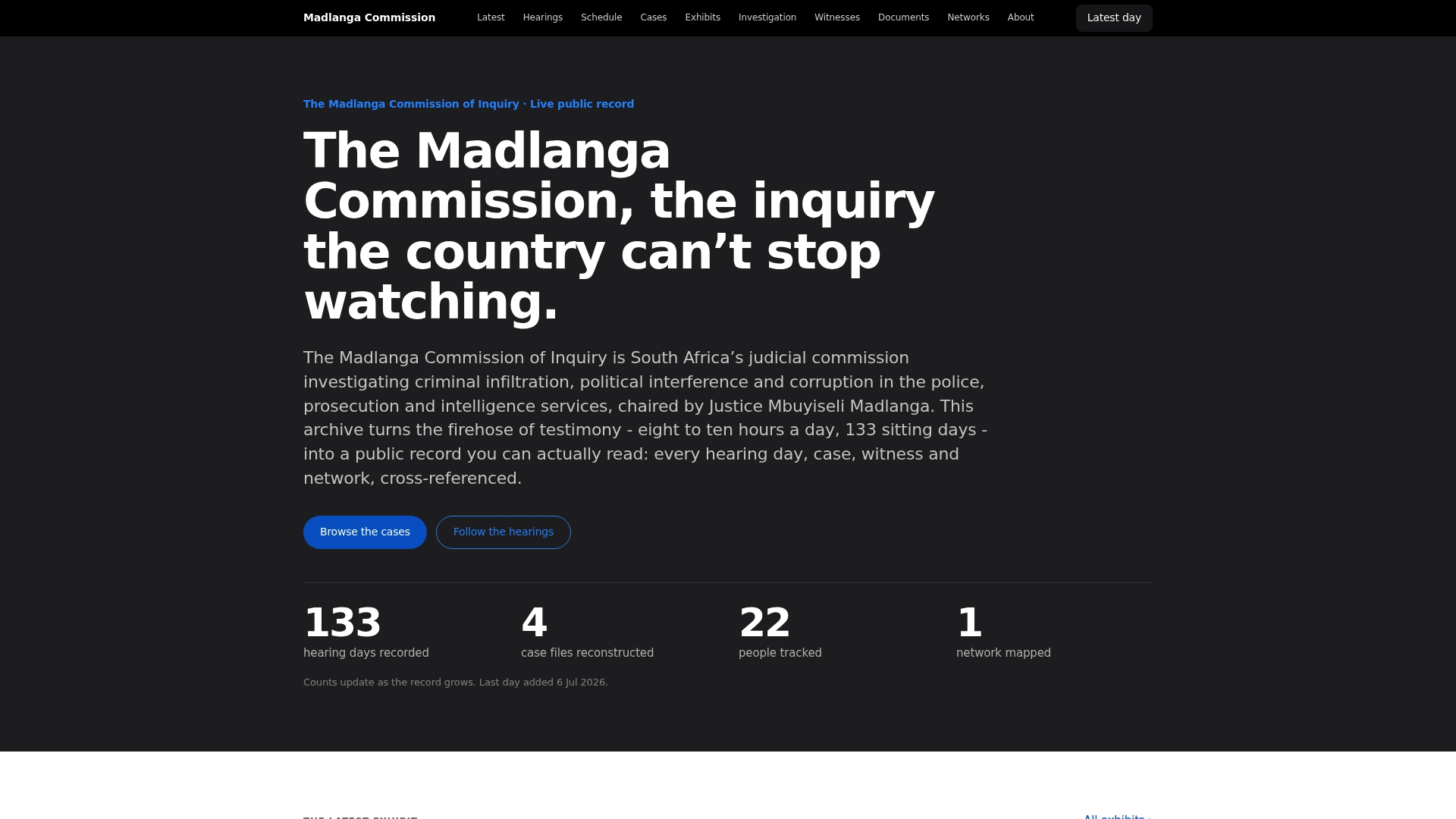
If you want to trace exhibits in the Madlanga Commission without watching the live feed, our archive brings together hearing days, witness profiles, case files, rulings and exhibits, cross-referenced so you can move between them. Start with The Investigation Room, our network of evidence, or open the main archive to browse the latest exhibits from the record.
For wider context on how the Madlanga inquiry fits among South Africa’s judicial commissions, see our guide to finding Madlanga records among judicial commissions. If you are interested in how a specific theme runs through the evidence, our piece on security vetting failures shows how documents and testimony fit together, and our note on self-incrimination in the inquiry explains how a witness’s rights interact with the documents they are asked about.
Common mistakes when working with exhibits
- Treating an exhibit as a finding. A commission receives documents to test them. Findings come in the report.
- Quoting from a screenshot of a screen. Check the underlying page. Exhibits shown during a hearing may be extracts.
- Losing the bundle reference. Numbers can repeat across bundles or commissions.
- Ignoring later testimony. A document can be explained, corrected or contradicted days or weeks later.
- Assuming a missing exhibit does not exist. It may be confidential, redacted or not yet published.
- Citing a media report as the source. Cite the record where you can, and the report only for what it adds.
FAQ
What is the difference between an exhibit and testimony at a commission?
Testimony is what a witness says under oath or affirmation, recorded in the transcript and on video. An exhibit is a document, recording or object the commission has received and given a reference. Witnesses often speak to exhibits, so the two are normally read together.
Is there a standard exhibit numbering system for South African commissions?
We are not aware of one national format that every commission follows. Each commission’s team labels its own exhibits, so always cite the commission, the bundle, the exhibit reference and the page together. If the exact label matters for a filing, confirm it with the commission’s secretariat.
Does an exhibit prove what it says?
No. Commissions are not bound by strict court rules of evidence, so they can receive material a court might refuse. The commission weighs an exhibit against testimony and other evidence, and states its view in its findings.
Can I get a copy of an exhibit that is not public?
Ask the commission’s secretariat in writing, giving the exhibit reference, the witness and the hearing day. The chairperson rules on written confidentiality claims, so an item may be redacted or withheld. A precise request is more likely to get a clear answer.
How should I cite an exhibit in a news story or legal paper?
Name the commission, the witness, the hearing date, the exhibit reference, the bundle and page, and where and when you viewed it. For quoted passages, keep the page number. A bare exhibit number is not enough.
Sources
- Commissions Act: Commission of Inquiry into State Capture rules (Government Gazette, 2018)
- Judicial Commission of Inquiry: Rules of the Judicial Commission (Government Gazette, 2025)
- Reporting the Courts: Commissions of Inquiry (SANEF court reporting guide)
- Prototype of general instructions and file plan for commissions (National Archives, 2003)
- Commissions Act, 1947 (LawLibrary)