The Commission of Inquiry Process in South Africa, Step by Step

A South African commission of inquiry runs in six stages. The President appoints it and sets its terms of reference. Investigators and evidence leaders gather evidence. Witnesses are summoned and testify, mostly in public hearings. The chairperson makes findings, and the commission hands a report to the President. The President then decides what to do with it. A commission is a fact-finding body, so its report is advice and not a court judgment. This guide walks through each stage, using the Madlanga Commission as the live example.
TL;DR
- A commission of inquiry is set up by the President, who also sets its terms of reference. It investigates, makes findings and recommends action. It does not convict anyone.
- When the Commissions Act applies, the commission has High Court-like powers to summon witnesses, take evidence under oath and demand documents.
- Hearings are public unless the chairperson orders otherwise. Evidence leaders lead witnesses through their statements, and cross-examination needs the chairperson’s permission.
- After the report, the President is not bound to accept its findings or recommendations. Implementation depends on political will and public pressure.
- You can follow the Madlanga Commission’s daily hearings through our searchable archive, without sitting through the live feed.
Table of Contents
- What a commission of inquiry is for
- The process at a glance
- Stage 1: Who establishes a commission, and how
- Stage 2: Powers and rules of procedure
- Stage 3: Evidence, witnesses and summonses
- Stage 4: How the hearings work
- How an inquiry differs from a court case
- Stage 5 and 6: The report and what follows
- What you can do while a commission sits
- Our perspective
- Follow the Madlanga Commission without the live feed
- FAQ
- Sources
What a commission of inquiry is for
A commission of inquiry is a fact-finding body, usually set up by the President to investigate matters of great public concern, make findings and recommend action. It can also reveal the truth to the public and serve public education.
The same legal guide for journalists, citing the Constitutional Court’s SARFU III judgment, describes commissions as bodies that determine facts and advise the President through recommendations. They are not courts of guilt or innocence.
Academic work points the same way. Lauren Kohn’s 2024 article in the Utrecht Law Review characterises commissions as fact-finding, truth-seeking and confidence-restoring mechanisms. Their recommendations can support institutional and legislative reform.
For a fuller definition and examples, see our guide on what a commission of inquiry is.
The process at a glance
| Stage | What happens | Who drives it |
|---|---|---|
| 1. Establishment | The President appoints the commission and sets its terms of reference | The President |
| 2. Preparation | Rules are published, evidence is collected, statements are taken | Commissioners, evidence leaders, investigators |
| 3. Hearings | Witnesses are sworn in and testify, documents become exhibits | Chairperson and evidence leaders |
| 4. Findings | The chairperson weighs the evidence against the terms of reference | Chairperson and commissioners |
| 5. Report | A report with findings and recommendations goes to the President | Chairperson |
| 6. Response | The President decides what to accept and implement | The President and government |
The sections below take these stages in turn.
Stage 1: Who establishes a commission, and how
The President may appoint a commission under section 84(2)(f) of the Constitution and sets its terms of reference. Those terms are the commission’s mandate. They list the questions it must answer and the institutions or conduct it may examine. They are usually published in the Government Gazette and on the commission’s website.
The Commissions Act does not automatically govern every presidential commission. Section 1 requires the President to declare, by proclamation in the Government Gazette, that the Act applies. That declaration matters because it carries the commission’s compulsory powers.
The chairperson of a judicial commission is usually a judge, often retired. In our case that is Justice Mbuyiseli Madlanga. The terms of reference are the yardstick for everything else. If a question falls outside them, the commission has no business answering it. We explain how these documents are drafted and read in our guide to terms of reference.

Stage 2: Powers and rules of procedure
When the Commissions Act applies, a commission has High Court-like powers: it can summon witnesses, take evidence under oath or affirmation, and demand documents and other evidence. The President’s terms of reference may set procedure and confer additional powers.
The Marikana Commission shows how far those extra powers can go. Its establishing proclamation gave it power to enter and search premises, secure witnesses and compel documents. It could also refer matters to a law-enforcement agency, government department or regulator for prosecution, further investigation or a separate inquiry.
Most commissions also publish their own rules. These deal with practical questions: who may attend, how witnesses are notified, how implicated persons respond, and how evidence is submitted. The rules for the commission now sitting were published in the Government Gazette in 2025. Read the rules of whichever commission you are following, because they differ.
Stage 3: Evidence, witnesses and summonses
A commission rarely starts with witnesses on the stand. Investigators and evidence leaders first gather documents, take statements and decide whom to call. Only then do hearings begin.
A witness may be summoned to attend and to remain until excused or until the inquiry concludes. The Commissions Act makes it an offence to fail, without sufficient cause, to attend or remain. Witnesses may also be required to take an oath or make an affirmation, and the commission may require answers and the production of books, documents or objects relevant to the inquiry.
Three practical points follow:
- A summons is compulsory. Ignoring it without good reason is a crime, not a courtesy.
- Evidence is sworn. What a witness says in the box is given under oath or affirmation.
- Documents travel with testimony. Cellphone records, bank statements and official files become exhibits that the evidence leader puts to the witness.
If you are summoned, or want to understand where a witness’s duties begin and end, read our pieces on evidence in inquiries and commission evidence rules. Refusing to cooperate can also amount to contempt, which we cover in contempt of inquiry. A person facing prosecution who may become a witness for the state should also read about what being a state witness means.
Stage 4: How the hearings work
This is the stage most people mean when they search for the inquiry process, and for “daily hearings” in particular.
Public by default
Under the published commission rules, hearings are public unless the chairperson orders an in-camera hearing. In-camera sittings are the exception, usually where a witness’s safety or the integrity of an investigation is at stake. Those who fear for their safety may also look at the witness protection route.
Who does what
The chairperson decides which witnesses testify and in what order. The evidence leader presents witness evidence and may question witnesses, including with leading questions where the chairperson permits. Legal representatives may assist their clients.
People implicated in the evidence may receive notice, their statements or relevant portions of them, details of the hearing, and an opportunity for legal assistance under the commission’s rules.
A typical hearing day
A day usually follows this pattern:
- The chairperson confirms the day’s witness, who takes the oath or affirmation.
- The evidence leader takes the witness through a sworn statement, paragraph by paragraph.
- Exhibits are put on screen or into the record as the witness refers to them.
- Commissioners ask their own questions as they arise.
- Where permitted, legal representatives of implicated persons question the witness.
- Proceedings adjourn for tea and lunch. If the witness is not finished, evidence carries over to the next sitting day.
This is why one witness can occupy several days, and why a single day can run for many hours. Past commissions published records organised by hearing day. A Truth and Reconciliation Commission amnesty hearing transcript, for example, shows a chairperson, an evidence leader, sworn testimony, examination and cross-examination in sequence. For that body’s history, see our explainer on the Truth and Reconciliation Commission.
Cross-examination is not automatic
In a trial, cross-examination is a right. In an inquiry it is a permission. The TimesLIVE legal analysis reports that the Madlanga Commission’s rules allow the chairperson to permit it on terms considered necessary and in the commission’s best interests. The same analysis notes that a chairperson may pursue important evidence directly and may consider material, such as hearsay, that a trial court would treat differently.
That is the inquisitorial model at work: the commission is looking for the truth, not refereeing two sides.
How an inquiry differs from a court case
| Commission of inquiry | Criminal trial | |
|---|---|---|
| Purpose | Establish facts and recommend action | Decide guilt and impose a sentence |
| Style | Inquisitorial | Adversarial |
| Outcome | Findings and recommendations | A binding verdict |
| Cross-examination | At the chairperson’s discretion | A right of the accused |
| Appeal | Not appealed like a judgment | Appeal available |
A commission is inquisitorial rather than adversarial and does not make binding findings that determine legal rights. A commission report is not appealed like a court judgment. A person may in some circumstances seek judicial review of how the report, or later executive action, was produced. The report’s recommendations do not themselves operate as a court order, according to the TimesLIVE analysis.
This does not make a commission toothless. Its findings can point prosecutors, regulators and Parliament to conduct that needs attention, and its public record can stand for years. The commission’s role is to put the facts on the record so that other bodies can act.
Stage 5 and 6: The report and what follows
At the end, the chairperson prepares a report that answers the questions in the terms of reference and recommends action. It goes to the President. The President is not bound to accept the commission’s factual findings or recommendations.
What happens next is mainly political. As The Conversation has noted, recommendations are non-binding, and implementation depends on political discretion and pressure for change. Journalists, civil society and ordinary citizens supply much of that pressure. They can only do so if they know what the commission actually heard.
What you can do while a commission sits
- Read the terms of reference first. They tell you what the commission can and cannot decide.
- Read the rules. They tell you who may question witnesses and how implicated persons are treated.
- Follow the exhibits, not only the headlines. Documents often carry more weight than a quoted line from testimony.
- Track witnesses over time. Evidence from one person is often tested or supported by another days or weeks later.
- Keep the report in view. Hearings are evidence. Findings come only in the report.
Journalists covering a commission should also know how to handle confidential material safely. See our guide to protecting sources in South Africa. Decisions taken by public bodies after a commission reports may also be reviewable, which we explain in our guide to administrative justice.
Our perspective
Anyone who has tried to follow a commission live knows the problem. Days run for eight to ten hours. Witnesses return across sittings. Exhibits are mentioned in passing and then matter weeks later. The process is sound in design, but it is hard to follow as it happens.
That is why we built our archive around the hearing record rather than the headline. A commission’s value to the public lies in its record: who said what, under oath, with which documents. When that record is cross-referenced across witnesses, cases and exhibits, a citizen, a journalist or a lawyer can see how evidence builds, without watching every hour of the feed.
We think understanding the process and reading the record belong together. Knowing that cross-examination is at the chairperson’s discretion, or that the President is not bound by the report, changes how you read a day’s testimony. A searchable, organised archive lets you test each claim against the documents in front of the commission.
Meriol Lainchyon
Follow the Madlanga Commission without the live feed
Our archive brings together daily hearing records, witness profiles, exhibits, rulings, statements and official documents from the Madlanga Commission of Inquiry. It is free to use and searchable, so you can follow developments on your own schedule.
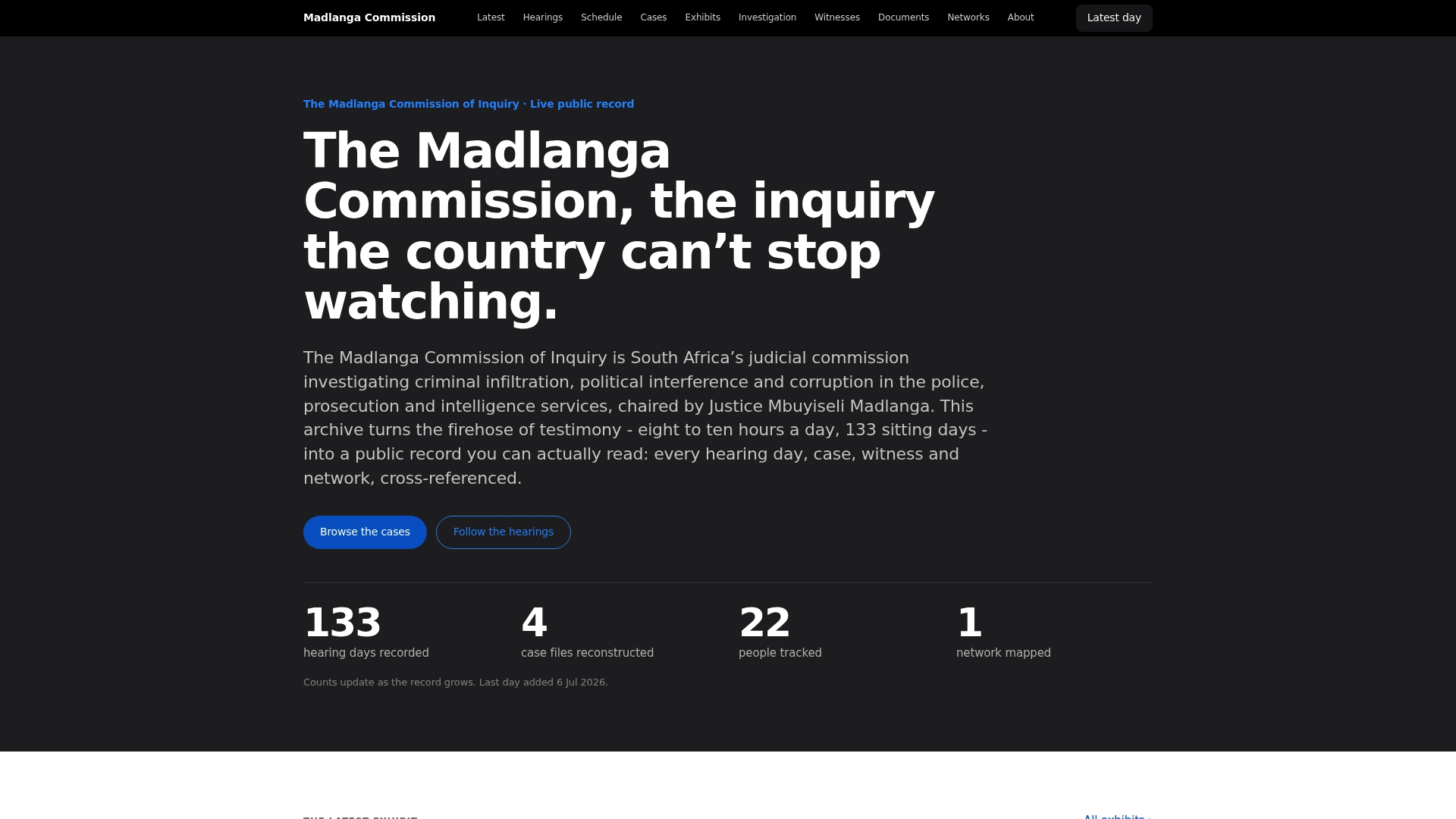
Start on the Madlanga Commission homepage, or go straight to a witness profile, such as Bevan Loftus, Imtiaz Fazel, Steve Motsumi or Mavuso Ntandane.
FAQ
Is a commission of inquiry the same as a court?
No. A commission investigates facts and recommends action, and it does not decide criminal or civil liability. Its procedure is inquisitorial, and its report is advice to the President, not a binding judgment.
Can a commission force someone to testify?
When the Commissions Act applies, yes. A commission can summon witnesses and require documents, and failing without sufficient cause to attend or remain is an offence. Witnesses may be required to testify under oath or affirmation.
Are commission hearings open to the public?
Usually. Under the rules published for the commission now sitting, hearings are public unless the chairperson orders an in-camera hearing. Check the rules of any other commission, as they can differ.
What happens after the commission finishes?
The commission submits its report, with findings and recommendations, to the President. The President is not bound to accept it. Whether recommendations are implemented depends largely on political discretion and public pressure.
Sources
- Reporting the Courts: Commissions of Inquiry (SANEF)
- Integrity & Accountability Commissions of Inquiry (Utrecht Law Review, 2024)
- Appointment of Judicial Commission of Inquiry on the Marikana tragedy (Presidency)
- Rules of the Judicial Commission of Inquiry (Government Gazette 53251, 2025)
- Commissions Act, 1947: Schedule
- Truth Commission amnesty hearing transcript
- Commissions of inquiry aim to probe and advise, not adjudicate (TimesLIVE, 2025)
- South Africa’s commissions of inquiry: what good can they do? (The Conversation, 2018)