Transcribing Hearings in South Africa: How to Get Records

If you need a hearing transcribed in South Africa, start by finding out whether a transcript already exists. For the Madlanga Commission, it does: daily hearing records are published and searchable, so you do not need to commission a transcriber. For court, CCMA, arbitration or disciplinary hearings, a transcript is usually made from an audio recording and only on request, and the route depends on the forum.
This guide covers both situations. It explains how a hearing becomes a written record, who can make one, what to ask for, and what to do when the record is missing or withheld.
TL;DR
- Check public archives first. Commission hearings are already transcribed and searchable in our archive, so there is nothing to commission.
- For courts and tribunals, a transcript is typically produced from the audio recording on request, so write to the registrar or clerk of the forum that held the hearing.
- If a record is not freely available, the Promotion of Access to Information Act (PAIA) gives you a formal route: Form 2, a fee, and a response period of 30 days.
- Withheld or redacted material is usually tied to privacy, commercial or security grounds, and severable parts must still be disclosed.
- Before you cite a transcript, record the hearing date, witness, page or timestamp and the source you used.
Table of Contents
- What “transcribing a hearing” actually involves
- Madlanga Commission hearings: the transcripts already exist
- When you do need a transcript made: courts, CCMA, arbitrations and disciplinary hearings
- Is it legal to record and transcribe a hearing yourself?
- What the law says about access to hearing records
- Why a transcript may be withheld, redacted or late
- What to do when a transcript or exhibit is missing
- How to cite a transcript properly
- Follow the Madlanga Commission without transcribing a word
- FAQ
- Sources
What “transcribing a hearing” actually involves
A hearing is a spoken event. The written record comes from one of three things: a stenographer or court reporter working live, a digital audio recording that is typed up afterwards, or a video stream of the proceedings. In South Africa, most formal forums record audio, and the transcript is a separate step done later by a typist or transcriber.
That separation matters for you. The audio is the primary record. The transcript is a product made from it, and it may not exist until someone asks for it and pays for it. Our guide on how to read hearing transcripts notes that magistrates’ courts transcribe their notes only when directed or when a party specifically requests and pays for it.
The word “transcript” therefore covers very different documents:
- A verbatim transcript records every word, including interruptions, repetitions and objections. This is what lawyers, journalists and researchers need.
- A clean-read or edited transcript removes false starts and filler. It is easier to read but should never be quoted as a witness’s exact words without checking the original.
- A summary or minute records decisions and key points. It is not a transcript and should not be cited as one.
When you ask for a transcript, say which of these you want, and say whether you need timestamps or speaker labels.
Madlanga Commission hearings: the transcripts already exist
The Madlanga Commission of Inquiry, chaired by retired Constitutional Court Justice Mbuyiseli Madlanga, investigates criminality, political interference and corruption in the criminal justice system. Its own website describes itself as the place for official records, live hearings, transcripts, statements and rulings.
Our archive complements that by organising the material so you can follow it without watching hearings live. It holds daily hearing records, case files, witness profiles, exhibits, official documents, rulings, statements and media briefings, cross-referenced to each other.
There are several ways to find what you need:
- By hearing day. Use this when you know when something was said, for instance a day covered in the news.
- By witness. A witness profile pulls together the testimony and related exhibits. For an example of how a profile is laid out, see Dr Ntandazo Sifolo’s page.
- By exhibit or document. Useful when a witness refers to an exhibit by number and you want to read it.
- By topic or case. Useful for researchers tracing a pattern across several witnesses.
For a step-by-step walk-through of downloading a specific transcript or exhibit, see our guide to getting Madlanga transcripts the same day. If you are new to inquiry material in general, start here for inquiry transcripts in South Africa.
Why you do not need to pay a transcriber for commission hearings
Commissioning a private transcription of a hearing that is already published duplicates work and adds a risk: a third-party typed version may differ from the published record. If you quote from a commission hearing, quote from the published record and note where you found it. Our guide to citing Madlanga inquiry transcripts sets out the elements a journalist should record.
When you do need a transcript made: courts, CCMA, arbitrations and disciplinary hearings
Most people searching this topic are in a different position. They were in a hearing, or act in one, and need the recording typed up. The practical route has four steps.
Step 1: identify the forum and the recording holder
The body that held the hearing holds the recording. For a court, that is the registrar or clerk of that court. For a bargaining council, tribunal, arbitration or internal disciplinary hearing, it is the body or the chairperson’s office. Write down the case number, date, courtroom or venue and the presiding officer’s name.
Step 2: ask in writing for the recording or transcript
Put the request in an email or letter. State the case number, the date or dates, and whether you want the audio, a transcript, or both. Ask what the cost is and how long it will take. Keep a copy of everything you send.
If you were a party to the hearing, say so. If you were not, expect more questions about why you want it, and read the PAIA section below before you go further.
Step 3: choose who types it
Where the forum allows you to obtain the audio and arrange your own transcription, you will be choosing between types of provider:
| Option | Best for | What to check |
|---|---|---|
| Forum’s own transcription service or official reporter | Records that may be used in court or on appeal | Whether the forum accepts only its own certified version |
| Specialist legal transcription company | Arbitrations, disciplinary hearings, depositions, affidavits | Experience with legal terminology, confidentiality terms, certification |
| General transcription freelancer | Research interviews, non-legal recordings | Not usually suitable for evidence, since accuracy and confidentiality are harder to verify |
| Your own typing from audio | Short clips for personal reference | Time cost, and you cannot certify the result |
Ask any provider how they handle multiple speakers, overlapping speech, indistinct audio, and the languages in the recording. South African hearings often switch between English, Afrikaans and African languages in a single session, and a transcriber who cannot follow the switch will leave gaps or guess.
Step 4: check the transcript against the audio
A transcript is only as good as the check you give it. Listen to at least the key passages while reading. Look for names, numbers, dates and negatives (“did” versus “did not”), because these are the errors that change meaning.
Is it legal to record and transcribe a hearing yourself?
Many readers also ask whether they can record someone without their knowledge. The answer depends on the setting. A hearing is not an informal conversation: courts and tribunals set their own rules on whether recording devices may be used, and a presiding officer can refuse or restrict them. Always ask the registrar, clerk or chairperson before bringing any recording device into a venue. For the rules on attending and watching hearings, see our guide to public access hearings in South Africa.
What the law says about access to hearing records
The Promotion of Access to Information Act (PAIA) gives effect to the constitutional right of access to information held by the State and by another person. It is the formal tool when a record is not freely available.
How to make a PAIA request
According to the government’s guidance, you submit Form 2 to the relevant public body. A request fee and an access or search fee may apply, and the deputy information officer must respond within 30 days. You are not obliged to state why you want the information when asking a public body.
Our separate guide explains the PAIA request process in South Africa in more detail. If you want to understand how PAIA relates to the privacy law that often shapes refusals, this explainer on PAIA and POPIA differences is a good companion read, especially for what happens when a request is transferred or denied.

A limit to know before you file
The government guidance states that PAIA should not be used if the record is requested for use in ongoing criminal or civil proceedings, or where such proceedings have already begun. If you are a party to a case, the court’s own rules on obtaining the record apply, so go to the registrar first.
Why a transcript may be withheld, redacted or late
A gap in the public record does not always mean something is being hidden. There are ordinary reasons and legal ones.
Legal grounds. The Act lists privacy, commercial information and defence or security among the grounds for refusing access. For private-body records, parts that can reasonably be separated and are not exempt must still be disclosed. In practice that is why you sometimes receive a document with blocked-out passages instead of a flat refusal.
Hearing format. Some testimony is heard in a closed session to protect a witness or sensitive information. Our guide to in camera hearings in South Africa explains how that works and what the public can and cannot expect to see.
Legal protections for witnesses. Questions about what a witness is compelled to say, and what they can decline to answer, are covered in our piece on self-incrimination in the Madlanga Commission inquiry.
Processing time. Transcription, checking and redaction take time. A recording can exist days before the verified transcript does. History shows the scale of the problem when it is not managed: researchers who examined the Truth and Reconciliation Commission’s archives described them as a national asset, yet much of the archive remained unprocessed and largely inaccessible. If you want the background, read our explainer on South Africa’s Truth and Reconciliation Commission.

What to do when a transcript or exhibit is missing
Work through these in order:
- Check the date and the witness again. Many “missing” records are filed under a different hearing day or a variant spelling of a name.
- Check whether the session was closed. If so, the transcript may be withheld on purpose.
- Wait a short while. Verified transcripts often follow the hearing day, not the same hour.
- Write to the body that holds the record, naming the day, the witness and the exhibit number.
- File a PAIA request if the record is not freely available. Use Form 2 and keep proof of submission, then diarise the 30-day response period.
- Keep what you receive. If a record arrives with redactions, note which grounds were cited.
Our guide to judicial commissions in South Africa shows where records from other inquiries tend to be kept, which helps when you are tracing material from an older commission.
How to cite a transcript properly
Whether you obtained it from an archive or a transcriber, a citation should let another person find exactly the same passage. Record:
- The name of the proceeding and the forum
- The hearing date
- The witness or speaker
- The page number, line or timestamp
- The place you accessed it and the date you accessed it
- Whether the version is verbatim, edited or a summary
This takes thirty seconds when you read, and hours to reconstruct later. For journalists working under deadline, the extra care also protects against a correction when a published transcript is later updated.
Our view: the record should be readable, not just available
Publishing a transcript is the first step, and it is not enough. A thousand pages of verbatim testimony, delivered day after day, are public in theory and unreadable in practice for anyone with a job and a family. We built our archive on the belief that a public inquiry belongs to the public, and that means making the record navigable.
That is why we cross-reference hearing days, witnesses, cases, exhibits and rulings. A reader who finds a witness should be able to see what was said, what documents were put to them and where the same names appear elsewhere. We aim to let you follow developments without sitting through the live proceedings.
Our advice for anyone who needs a hearing on paper: check what is already published before you pay for a transcription, and cite the published record when it exists. Where a record truly is not available, use the legal routes set out above and keep your paper trail.
Meriol Lainchyon
Follow the Madlanga Commission without transcribing a word
Our archive is free to use. It gathers hearing records, witness profiles, exhibits, rulings and statements in one searchable place, so journalists, researchers, legal professionals and citizens can find a passage in minutes.
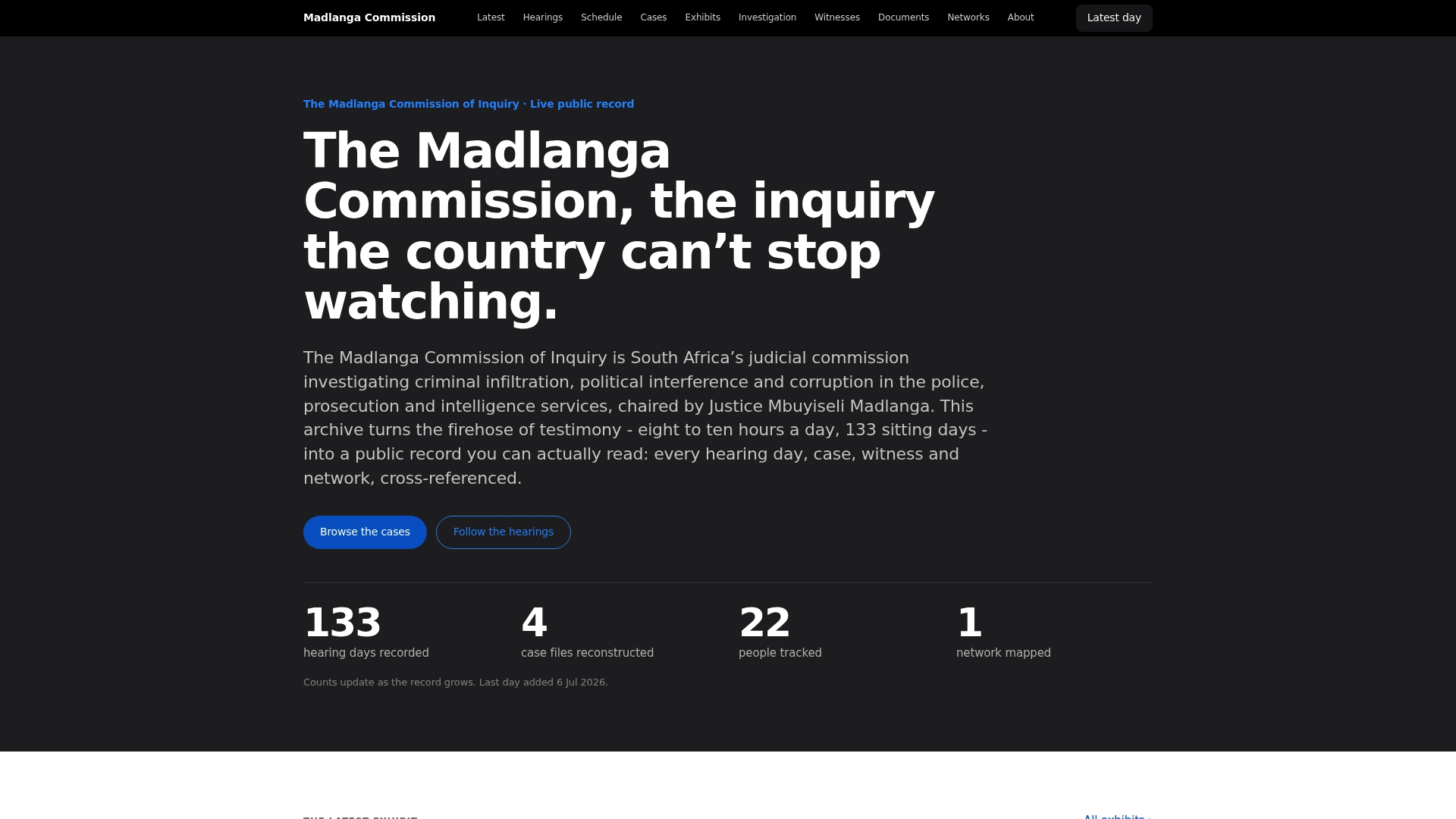
To see how a witness profile connects testimony and documents, open Dr Ntandazo Sifolo’s profile, or go to the Madlanga Commission archive and search by hearing day.
FAQ
Where can I find Madlanga Commission transcripts?
They are published in the Commission’s records and in our searchable archive, organised by hearing day, witness, exhibit and case. Start with the day or witness you know and move to related documents from there.
Do I need to pay someone to transcribe a hearing?
Not for commission hearings that are already published. For court, arbitration or disciplinary hearings, a transcript is generally typed from the recording on request, so ask the registrar or the body that held the hearing what it costs and who may do the work.
How do I get a record that is not publicly available?
Submit Form 2 under PAIA to the relevant public body. A request fee and an access or search fee may be payable, and the deputy information officer must respond within 30 days. You do not have to give a reason for wanting the record.
Why are parts of a transcript blacked out?
PAIA allows refusal on grounds such as privacy, commercial information and defence or security, and parts that can reasonably be separated must still be disclosed. Closed sessions can also keep testimony out of the public record.
How do I cite a hearing transcript?
Note the forum, hearing date, witness, page or timestamp, the version type and where and when you accessed it. That lets anyone else locate the same passage.
Sources
- Access to information | South African Government
- Promotion of Access to Information Act No. 2 of 2000
- Accessing the Records of the Truth and Reconciliation Commission
- Judicial Commission of Inquiry into Criminality, Political Interference and Corruption in the Criminal Justice System